Where can you see the Northern Lights in Russia, and when is better to do it? The most promising locations, how easy they are to reach, the cost of organized tours. What you need to know, how to prepare for a Northern Lights photography trip, increase your chances of seeing the Aurora in different regions of Russia — Eurotraveler covers all this.
Many travelers dream of seeing the Northern Lights with their own eyes, whether they’re seasoned explorers or just starting out. However, to turn that dream into reality, it’s worth preparing for a few practical inconveniences and even a certain degree of self-sacrifice.
The thing is, this natural phenomenon prefers to make its home at high latitudes — close to Earth’s poles. And — as even elementary school students know, the climate in these regions is harsh, whether you’re in the north or the south.
- In Russia, the best way to hunt for the Northern Lights is beyond the Arctic Circle, in the territories surrounding and even within the Arctic itself
- In other words, around places where transport links and other infrastructure are often underdeveloped, to say the least, and in some cases — completely nonexistent.
That said, this doesn’t mean your chances of seeing those amazing bursts of color in the night sky are close to zero. Quite the opposite! In recent years, even residents of St. Petersburg and Moscow, cities in central Russia, have had a chance to see the aurora borealis right from their balconies or apartment windows!
In October 2026, for example, exceptionally bright auroras lit up the night sky across many Russian regions. They were spotted in the Moscow Region, Tatarstan, and Mari El, as well as in the Urals and Yakutia: science.mail.ru/news/58455-polyarnoe-siyanie-11-oktyabrya-2026-v-rossii/.
That said,
the basic rule still holds: your best chance of catching the aurora is in the north of the country, where fewer people live and, consequently, light pollution is much lower.
In other words, these are places where virtually ideal conditions exist for observing a stream of excited particles entering Earth’s atmosphere…
In this guide, we’ll focus primarily on places in Russia where you can see the Northern Lights without taking any dangerous risks and in reasonably safe conditions. And, of course, we’ll tell you which time of year offers the best chances of witnessing this natural phenomenon.
Let’s start with a few lines borrowed from Wikipedia, which explain the subject better than we could:
What Are the Northern Lights?
This natural phenomenon, also known as the aurora borealis or polar lights, occurs in Earth’s atmosphere when large numbers of charged particles enter it. These particles are released by the sun, and their numbers increase significantly after major solar flares.
Streams of particles, commonly known as the solar wind, enter Earth’s ionosphere near the planet’s poles. When they interact with the gases present there, the lights appears.
In other words, the Aurora that so many people dream of witnessing!
- The brightness and intensity of the Northern Lights depend heavily on the duration and strength of solar flares
- So, if you install an app on your smartphone that tracks solar activity and geomagnetic storms on Earth, you’ll put yourself in a much better position to see the aurora.
For you’ll be able to head out at just the right moment, when conditions are most favorable for observing it.
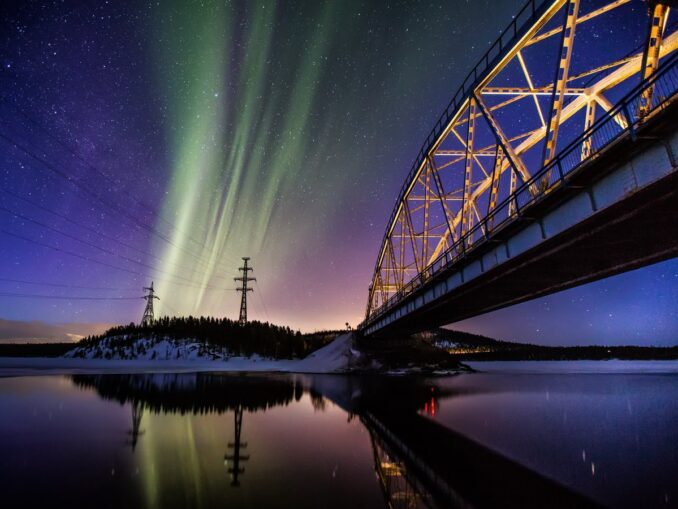
Taking a guided tour with guides who know the subject inside out can improve your chances even further. Because they can often predict with a high degree of confidence when and where you’ll be able to see the Northern Lights in all their glory.
You Can Usually Spot
the aurora from late summer through roughly mid-spring, when the hours of darkness are at their longest. For example, in Murmansk in early winter, the sun doesn’t rise above the horizon at all.
A lot also depends on the clouds: when the sky is overcast, the chances of enjoying this spectacular natural phenomenon are minimal
Naturally, the best viewing spots are outside cities. Sometimes the aurora is so faint that it’s difficult to make out against the glow of a residential neighborhood.
Getting to the best observation spots can be challenging, especially in winter, when roads are covered in snow and deep drifts block the way. On top of that, you may have to head out on particularly cold, but thankfully clear nights.
Where Can You See the Northern Lights
in winter as well as in other times of year? In autumn, for example, or even in late spring?
First of all, we’ll focus once again on the north of the country: places that are often difficult to reach and inherently rather cold.
We’re not denying that some people have spotted the Northern Lights simply by stepping onto the balcony of their apartment in St. Petersburg on an autumn or winter evening. But,
- First, these sightings are the exception rather than the rule. You could do the same thing for years without getting even the slightest chance of seeing the aurora.
- Second, against the brightly illuminated sky of a major city, the lights still tend to look rather faint.
At least, that’s usually the case. Sometimes, though, the opposite happens.
In early May 2024, for instance, almost all of Russia had a chance to witness a late-season aurora: dp.ru/a/2024/05/11/jarkoe-severnoe-sijanie-nabljudali. Meteorologists attributed the phenomenon to an exceptionally powerful geomagnetic storm triggered by the Sun, the strongest in 20 years.
Now let’s look at the places in Russia where your chances of seeing this remarkably beautiful natural spectacle are naturally the highest. And first on our list is:
Karelia
Karelia offers an excellent chance of witnessing this natural phenomenon. This vast region in northwestern Russia is sparsely populated, despite its considerable size.
It’s also easy to reach: even a relatively inexperienced people can drive to Karelia from Moscow or St. Petersburg. Again, there is no need to drive yourself: regular trains connect the Russian capital with Petrozavodsk.
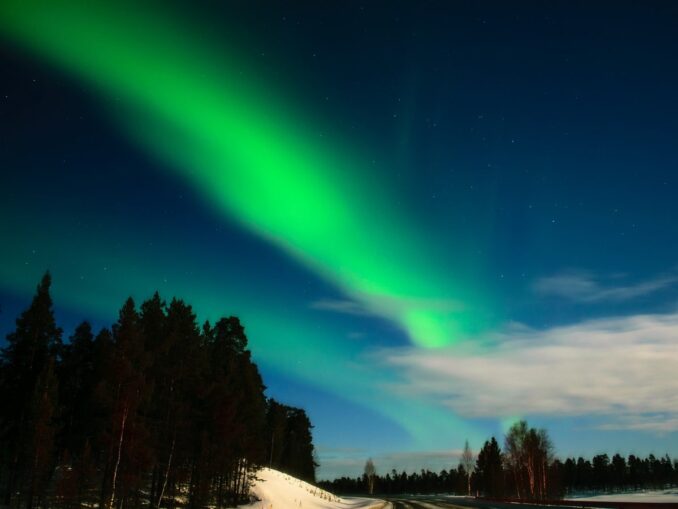
Of course, you can’t always count on seeing the aurora right in Karelia’s capital.
- But who’s stopping you from exploring Petrozavodsk first and then heading toward Medvezhyegorsk?
- Or even get to the Paanajärvi National Park, which is set in hilly terrain and therefore excellently fit for catching the aurora?
A self-organized road trip to Karelia looks like the most budget-friendly option — you’ll only need to pay for car’s fuel, meals and accommodation. If you’d like to join a local guide for an aurora photography tour, expect to pay an additional fee of 5,000–7,000 rubles (€50-70) or more.
By the Way
winters in Karelia aren’t particularly cold. But there’s usually plenty of snow, so you can also spend your days skiing, snowboarding, or even sledding until you’re completely worn out.
Transport and accommodation infrastructure are also well developed here. Regional roads boast smooth, newly laid surfaces and are cleared fairly promptly after snowfall.
As for the standard of tourist lodges, guesthouses, and short-term rental apartments in Petrozavodsk and Sortavala, their facilities and comfort levels are remarkably high.
Murmansk
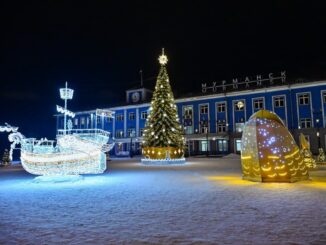
Murmansk is known as the world’s largest city north of the Arctic Circle and the unofficial capital of the Russian Arctic. It’s worth visiting in its own right, as well as serving as an excellent base for exploring the other attractions of the Kola Peninsula.
Including the Northern Lights!
Deciding to embark on this kind of a trip is relatively easy — driving from Moscow to Murmansk is perfectly doable. And once you get there, you can use your car to explore the region.
You can do this even in January or February, provided your vehicle has sufficient ground clearance and all-wheel drive.
What’s more, Murmansk has relatively mild winters. This means you can see the Northern Lights in fairly tolerable temperatures of -10 to -15°C, rather than in the harsh cold of around -30°C.
In the last case, as you can easily imagine, you’ll probably have other things on your mind than photographing the aurora…
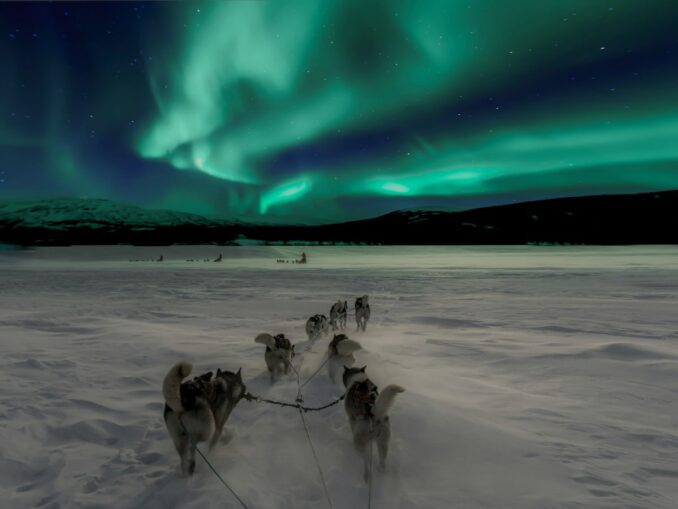
Of course, if you want to get a good look at the aurora, it’s best to leave Murmansk behind. And the farther you get from civilization, the better!
In 2026–2027, professionally organized Northern Lights tours cost from 3,500–5,000 rubles (€30-50) each here.
Online travel guides
Reasonably Recommend
going about 100 kilometers away from Murmansk to maximize your chances on a success. One of the possible options is to take a guided tour to Teriberka, where there’s plenty to see even without the Northern Lights!
Others venture even farther, heading to the ski resorts in the Khibiny Mountains. And why not? Watching the sky glow with color from the slopes of Kukisvumchorr, about 25 kilometers from Kirovsk, sounds like a pretty good idea.
Which other Russian city lets you see the Northern Lights without sacrificing comfort? We’d recommend taking a look at:
Arkhangelsk
This major regional center is at least as accessible as Murmansk, and in some respects even easier to reach, particularly if you’re planning to travel by car or train to the shores of the White Sea.
- The distance from Moscow to Arkhangelsk is shorter (1,250 km)
- And so is the journey time (from around 17 hours)!
In Russia’s Arkhangelsk Region, you can see the aurora borealis from late September until roughly late March or mid-April. Naturally, as with the destinations mentioned above, your chances of witnessing this natural phenomenon increase considerably in winter.
Winters in the Arkhangelsk Region are very cold, which often means clear skies.
As a result, you may be able to spot green and red auroral lights not only at night but even in the evening, right in the regional capital.
For the best viewing experience, though, travel guides recommend heading a little way out of town. One option is Malye Korely, a fascinating open-air museum complex about 25 kilometers to the south.
You could even stay at a nearby tourist lodge for a night or two, relax, and spend some time watching the sky.
Syktyvkar
The capital of the Komi Republic lies considerably farther south and east than Arkhangelsk. However, that won’t necessarily reduce your chances of capturing this remarkable spectacle in your memory—or on camera.
In fact, you may even catch the aurora in summer without leaving the city!
On one occasion, for example, residents of Syktyvkar watched and photographed an astonishingly vivid green glow in the sky straight from their balconies in the second half of August!
The aurora was so bright that the surrounding area was bathed in rich, grassy-green hues. You can see the photos and judge for yourself here: komiinform.ru/news/238510.
- A winter trip to Syktyvkar is an unusual idea, but not the best one
- Since the city lies far from the warming influence of the sea, temperatures can plunge to -35 to -40°C on some days.
Besides Syktyvkar, the Komi Republic is also home to Vorkuta, a major city in the far north of the region.
According to a widely held view online, Vorkuta is a «depressed» city, seemingly shrouded in the unsettling legacy of Vorkutlag, the former Soviet labor camp.
In recent years, however, Vorkuta has been attracting increasing numbers of curious travelers. One reason is that the city offers a good chance of capturing the glowing night sky on camera.
Salekhard
The only city in Russia located directly on the Arctic Circle, Salekhard is another place where you’re highly likely to see the Northern Lights. You may even catch them before winter arrives and the severe frosts set in. In recent years, residents have witnessed this natural spectacle as early as October, before the middle of autumn.
Getting to Salekhard, the capital of the Yamalo-Nenets Autonomous Okrug, from Moscow is relatively easy, as regular flights connect the cities.
- Tickets aren’t particularly expensive, considering the distance and the circumstances, and the flight itself is fairly short
- So in about four hours you’ll travel from Moscow’s Domodedovo Airport to the banks of the mighty Ob River.
Krasnoyarsk Region
Now this is something of an adventure. The Krasnoyarsk Territory stretches from the Arctic Ocean almost to the Mongolian border. While its southern part is well settled and developed, there are far fewer signs of civilization in the north.
Naturally, your chances of seeing the Aurora are particularly high in the village of Khatanga on the Taymyr Peninsula and on the nearby Putorana Plateau. We’d even go so far as to say they’re about as good as they get!
The Northern Lights are especially vivid in this part of Russia. Their colors sometimes include not only shades of green but also pink and violet hues, making the spectacle even more mesmerizing. It’s quite something to justify the journey, especially considering that temperatures in Khatanga can plunge to -30°C even in early winter.
- Unfortunately, getting to this settlement isn’t easy, despite the presence of an airport
- There are no direct flights from Russia’s major cities, so you’ll have to connect through Norilsk or Krasnoyarsk.
As a result, the journey one way can take anywhere from 32 hours to two days. A plane ticket will cost approximately 35,000–40,000 rubles (€350-400).
- Where to celebrate New Year’s Eve in Russia
- Most interesting Russian cities to visit in winter
- Where to see whales in Russia
© Eurotraveler