
How to get to Milan by plane, train, bus, or car? What’s the best (and cheapest) way to reach the city center from Malpensa and Linate airports, or from Bergamo? Which option should you choose? The Eurotraveler team has compared travel times and costs (2026 prices) and highlighted other important things to know when planning an independent trip to Milan.
Milan is Italy’s second-largest city by population and one of the country’s leading tourist, cultural, and business hubs. People come here not only to see the famous Milan Cathedral, Sforza Castle, and Leonardo da Vinci’s masterpiece The Last Supper. The capital of Lombardy also attracts fashion and shopping enthusiasts, fans of Italian cuisine, football supporters, and travelers planning trips around northern Italy.
After all, Milan is worth visiting in its own right, but it also makes an excellent base for exploring:
- Lake Como, Lake Maggiore, and Lake Garda,
- Bergamo, Verona, Venice, and other beautiful cities in northern Italy.
It’s hardly surprising, then, that getting to this major city is relatively easy. You can reach Milan by almost any means of transport: plane, high-speed train, intercity bus, or private car.
What’s more, travelers can choose not only their preferred mode of transport but also their arrival airport. Milan is served by three of them: Malpensa, Linate and Orio al Serio (Bergamo). They are located at different distances from the city, which means transfer costs can vary considerably.
More on getting around and other transport-related details below!
To Milan By Plane
Flying is the most convenient way to reach Milan from European cities located some distance away as well as from other countries. However, it’s important to check exactly which airport your chosen flight arrives at.
- That’s because the airports serving Milan are located at different distances from the city.
- And transfer costs can have a significant impact on your overall travel budget.
Malpensa Airport (MXP)
Malpensa is considered Milan’s main international airport. It’s located approximately 45–50 km from the city center and handles a large number of international and intercontinental flights.
The airport has two passenger terminals — T1 and T2. Most scheduled international flights operate from T1, while T2 has traditionally been used by low-cost airlines.
How to Get from Malpensa to Milan
The fastest way to reach the city center is to take Malpensa Express. Trains depart directly from the airport and serve both terminals. In Milan, they stop at the following stations:
- Milano Centrale — the city’s main railway station. It’s convenient for tourists planning onward journeys around Italy or staying near the central station (in this sense Residence De La Gare is not cheap, but genuinely an excellent choice).
- Milano Cadorna — a station in the western part of the city center, with convenient access to Sforza Castle and the historic center.
- Milano Porta Garibaldi — another major railway station, well suited for reaching the northern part of the city center.

Travel Time
depends on the route: the express takes approximately 37 minutes from the airport to Cadorna and around 50-55 minutes to Centrale.
Malpensa Express trains run regularly, although timetables vary depending on the route and time of day. In 2026, a standard one-way adult ticket costs €15.
A child ticket for passengers aged 4-13 costs €7.50. Children under 4 travel free when accompanied by an adult.
Tickets can be purchased online, through the Trenord app, or at ticket offices and machines at the airport railway station. If you buy a return ticket online, you can take advantage of a €25 round-trip fare, valid for travel within 30 days.
You can check timetables and buy tickets here: trip.com/trains/italy/route/milan-malpensa-airport-to-milan/.
Another Good Option
is to take a shuttle bus from Malpensa Airport to Milan. Several operators run services between the airport and the central railway station. The journey usually takes 50-70 minutes, although heavy traffic can make it considerably longer.
Ticket prices depend on the operator, booking date, and fare conditions. Expect to pay around €10-12 for a one-way journey. Some of the available operators include Malpensa Shuttle and Terravision.
- The bus is particularly convenient if you want to travel directly to the central railway station and don’t intend to use the train.
- However, be sure to factor in possible traffic jams and the time of day.
Finally, you can take a taxi. Bear in mind that a taxi from Malpensa to Milan is an expensive option. As of November 2026, the fixed fare for a journey from the airport to any district of Milan is €114.
This is a fixed fare for the designated route, not an approximate estimate based on the meter!
A taxi is worth considering primarily for:
- families,
- groups of several people,
- travelers with lots of heavy luggage,
- or those arriving late at night.
Linate Airport (LIN)
Milan has another airport, too — Linate. It’s located just about 7 km from the city center, making it particularly convenient for anyone who wants to get to their hotel as quickly as possible.
Linate mainly serves domestic and European destinations. Unlike Malpensa, it’s practically integrated into the city’s public transport network.

The easiest way to reach the city center is to take metro line M4 (the blue one). It connects the airport with central Milan and provides access to interchange stations, including San Babila.
The journey to San Babila takes around 12 minutes. The fare is based on the current ATM public transport rates (official website in English: atm.it/en/Pages/default.aspx).
You can pay for your journey using:
- a public transport ticket,
- a contactless bank card,
- or the relevant mobile app.
Taxis are also available right outside the terminal. Thanks to the short distance to the city center, a ride is usually cheaper than from Malpensa or Bergamo, although the final price depends on your destination and traffic conditions.
If the difference in airfares is small, Linate is often the most practical airport to fly into when visiting Milan.
Bergamo Airport (BGY), or Orio al Serio
Another airport serving the region is Orio al Serio, commonly known as Bergamo Airport.
It’s located approximately 50 km from central Milan and is widely used by low-cost airlines. Numerous budget flights arrive here, so it’s worth checking this airport when looking for cheap airfares.
Despite its name, the airport isn’t actually in Bergamo but just outside the city. There are several ways to get from there to Milan.
The Easiest Option
is to take a shuttle bus to Milano Centrale railway station. Several operators run direct services, including Autostradale, Flibco, Orioshuttle, and Terravision.
The journey usually takes 50-60 minutes, although traffic conditions can affect travel times.
In 2026, one-way tickets start at around €5 when booked online using promotional fares. Prices and conditions may vary depending on the travel date and seat availability.
A useful website for checking timetables and booking tickets is terravision.eu/airport_transfer/bus-bergamo-airport-milan/.

Another option is to take a bus to Bergamo railway station first and then catch a train to Milan. Local operator ATB runs buses between the airport and the city.
This is a good option if you’d like to explore Bergamo along the way or plan to spend a few days there.
A taxi directly from Bergamo Airport to Milan will cost considerably more than a bus. A fixed fare of €128 applies to the designated route.
- So, if you’ve decided to book a (usually inexpensive) flight to Bergamo, remember to add the transfer cost to your budget.
- Sometimes, a more expensive flight to Malpensa or Linate actually works out cheaper overall.
How to Get to Milan by Train
The capital of Lombardy is one of Italy’s most important railway hubs. It’s easy to reach by train from most major Italian cities, as well as several European capitals.
Within Italy, the main services are high-speed Frecciarossa trains operated by Trenitalia and Italo trains. They connect Milan with Rome, Florence, Bologna, Turin, Venice, Naples, and many other cities.
For example:
- the journey from Rome takes approximately 3 hours (here’s our guide to getting from Milan to Rome),
- from Florence — around 2 hours,
- from Bologna — approximately 1 hour,
- from Turin — around 1 hour.
Ticket prices vary considerably depending on how far in advance you book, the season, and the class of service you choose. The earlier you book, the better your chances of finding an attractive fare. Cheap seats often sell out as the departure date approaches.
International travelers can also take advantage of rail connections from France, Switzerland, Austria, and Germany.
You can travel directly from Paris to Milan on high-speed trains, while journeys from Barcelona require transfers. Rail connections to Munich and Vienna also involve changing trains.

Before
buying a ticket, it’s worth comparing offers from several operators:
- Trenitalia — Italy’s national railway operator.
- Italo — a private operator specializing in high-speed trains.
- SNCF Connect — trains in and from France.
- ÖBB — for travel around Austria and to other countries in Central Europe.
Milan’s main railway station is Milano Centrale. This impressive building features monumental architecture and is worth seeing in its own right. Trains depart from here to numerous Italian cities, as well as several international destinations.
Another important station is Milano Porta Garibaldi. It serves a number of regional, high-speed, and international routes.
- One major advantage of trains over planes is that you don’t need to travel to a distant airport in advance or spend time going through lengthy check-in procedures.
- If you’re traveling between Italian cities, taking the train is often the most comfortable option.
How to Get There by Bus
Traveling by bus remains a popular way to save money when getting around Italy. It’s particularly convenient for those who aren’t too pressed for time and are willing to trade speed for a lower fare.
Buses operated by international company FlixBus and several local providers connect Milan with other major Italian cities.
For example:
- you can reach Milan from Turin in approximately 2 hours,
- from Venice — in 4-5 hours,
- from Rome — in around 8-10 hours.
The exact journey time depends heavily on the route and traffic conditions.
With advance booking, tickets on some routes can be found for as little as €8-15. Fares increase considerably on weekends, public holidays, and during the peak tourist season.
Bus travel has several advantages:
- It’s usually the cheapest way to travel between cities.
- You can find direct routes without having to change buses.
- Some services depart late in the evening or overnight, allowing you to save on accommodation.
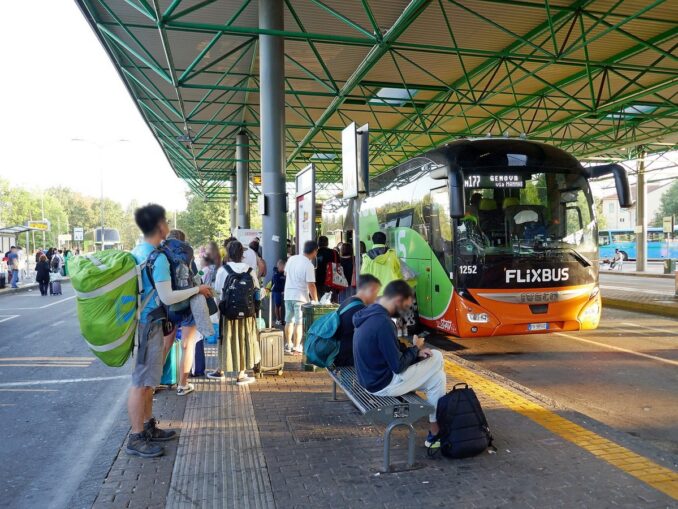
However, there are some obvious downsides, too. Journeys take longer, and traffic jams can add considerably to travel time.
- Bus seats are generally not particularly comfortable and can cause back pain and stiff legs.
- What’s more, bus stations aren’t always located right in the city center.
Getting to Milan by Car
This is a good option for anyone planning an independent road trip through northern Italy, visiting smaller towns and exploring the lakes of Lombardy.
However, renting a car solely to travel to Milan from another major Italian city usually doesn’t make much sense. Italy has an excellent railway network, while traffic in the city itself can be quite heavy.
Here are the main challenges you may encounter on a road trip of this kind:
- Toll motorways. Most Italian expressways charge tolls based on the distance traveled.
- Fuel costs. Petrol and diesel prices fluctuate regularly and, as of November 2026, remain above €2 per liter.
- Parking in central Milan can be quite expensive, and finding an available space isn’t always easy.
- Traffic restrictions. The city has a large restricted traffic zone (ZTL) — Area A — where a fee is charged for entry. There are also several smaller restricted zones. In addition, certain areas are off-limits to vehicles below Euro 4 emissions standards for petrol engines and below Euro 6 for diesel engines. Find out more here: autovia.it/en/ztl-milan-guide/.
To help you plan your journey, here are the approximate distances between Milan and some of Italy’s most popular tourist destinations:
- Venice — around 270 km.
- Turin — around 140 km.
- Florence — around 300 km.
- Rome — around 575 km.
- Verona — around 160 km.
Here you can read how to plan a three-day sightseeing trip around Milan. And there you will find details of how sales work in Italy.
© Eurotraveler

