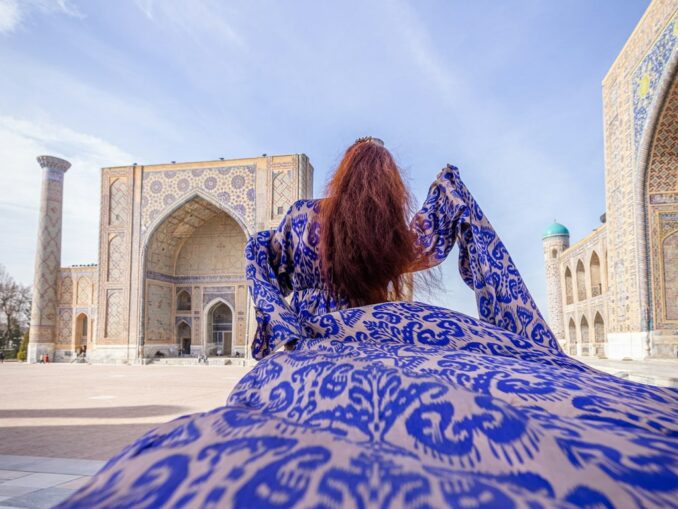
What to See in Samarkand in 1-2 or 3 days independently or with a tour? All the best attractions and sights, descriptions, and history. In what order should you visit Samarkand’s interesting places, what to see first, where to go in the surrounding area — Eurotraveler tells you all the truth.
The ancient capital of the Timurid Empire, Samarkand, to this day remains an amazing city. What’s more, it is also very convenient for travelers who do not tend to stay in one place for too long. After all, you can see Samarkand in just 2 days!
That is, if you don’t arrive particularly early and are not planning to move further on the very next day (for instance, to Bukhara). Those who dislike rushing and prefer to take their time, can easily spend 3-4 days here.
Without getting bored — there are plenty of interesting places in Samarkand.
And if you decide that you have already seen everything, take a trip to Shakhrisabz, Tamerlane’s «hometown». After all, when else will you get the chance to visit this small but incredibly historic town?!
Still, in this article we will focus primarily on what you need and can see in Samarkand itself. And, let’s repeat, there is quite a lot.
Those who don’t have time to explore Samarkand independently and in depth, can take a guided walking tour of the city. Fortunately, entertainments of such sort are now relatively affordable and can save you a lot of energy.
The Main Sights of Samarkand
Without overthinking it, virtually all tourists begin their exploration of the city with a visit to Registan Square. The more farsighted ones even stay nearby, especially since finding an inexpensive yet decent hotel within a 5-minute walk of the square is easy!
Personally, we recommend the inexpensive and cozy Samarkand Travel. But some of you will probably want to stay at a hotel overlooking the square…
The very name «Registan» sounds grand and impressive.
Although in fact, translated literally, it simply means «a place covered with sand»
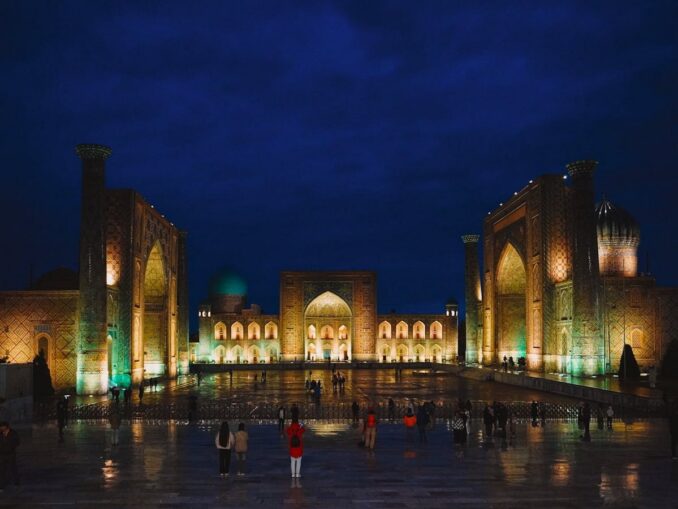
You won’t find any sand here, though — everything is quite civilized. But you will have to pay an entrance fee to the «perimeter»!
During the high season, which begins here on February 20 and lasts almost until the beginning of winter, Registan is open to visitors from 7 o’clock (7 a.m.) to midnight. But if you come to Samarkand in late November or, for example, around New Year’s Day, you will only be able to visit the city’s main square from 8 o’clock (8 a.m.) to 20 (8 p.m.).
- Tickets can be purchased online directly from the official website — registon.uz/
In the evenings, the square hosts a memorable laser show. And the lighting of the entire complex is so magical that it vividly brings fragments of Eastern fairy tales to mind.
The main thing to see at Registan Square in Samarkand is the architectural ensemble of three madrasas: Ulugh Beg, Sher-Dor, and Tilla-Kari.
Madrasas
are Muslim educational institutions. And from their sheer size, you can easily imagine how much importance was already attached to education here in the 15th century.
The richness of their decoration also makes it perfectly clear that the builders of Samarkand’s madrasas were not lacking in imagination or skill. Or indeed in money!
The oldest of the madrasas on the square is named after Tamerlane’s grandson, Ulugh Beg, who became famous as a great astronomer.
Mathematics and astronomy, as well as philosophy and theology, were once taught within the walls of this educational institution. Today, tourists
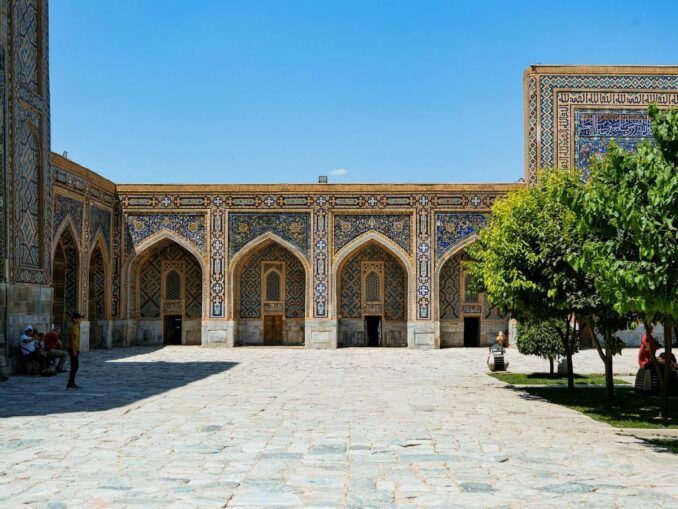
can see the madrasa not only from the outside but also from within, stroll through the courtyard, and look into the students’ rooms
Sher-Dor and Tilla-Kari madrasas were built later, in the 17th century. The latter looks particularly magnificent, which is precisely what its name suggests, literally meaning «Gilded».
Gur-e-Amir Mausoleum
The blue ribbed dome of the mausoleum where Amir Timur lies buried can be seen from almost anywhere in Samarkand. Naturally, this landmark is one of those places that should definitely be visited.
After all, this family tomb contains not only the remains of Tamerlane, creator of a vast empire, but also those of his spiritual mentor, as well as his sons and grandsons. Amir Timur’s gravestone is made of black nephrite, which, according to legend, once adorned Genghis Khan’s throne.
Guided tours inside the crypt are not customary — in Samarkand, people still remember the legends that disturbing the remains of the conqueror buried here is asking for trouble.
Local guides love to tell the story of how the Iranian ruler Nader Shah tried to take Timur’s gravestone away, but quickly changed his mind
because natural disasters began occurring in his domains
Another story is also well known. In June 1941, a group of Soviet archaeologists opened Tamerlane’s tomb, ignoring warnings from local elders who pleaded with them not to unleash the «spirit of war».
As a result, the bloody Great Patriotic War soon began.
Those tourists who head north from Registan Square rather than south toward Gur-e-Amir, following the wonderfully wide and well-maintained pedestrian Tashkent Street, will reach Bibi-Khanym Mosque and Siab Bazaar.
Bibi-Khanym
It is known that Tamerlane built this mosque in honor of his wife. And, according to the rumors, Bibi-Khanym herself not only supervised the construction while her husband was away but also fell in love with the architect.
Whether that is true or not, the architect was executed after Amir Timur returned from his campaign. According to one version, it was because the building he had created was not monumental enough.
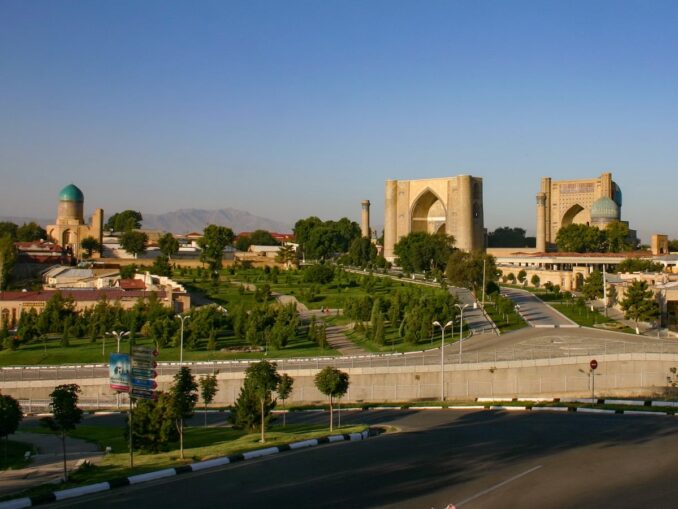
Bibi-Khanym Mosque is currently being restored, but that certainly does not prevent visitors from marveling at its immense scale and splendor
Take a look at the enormous marble lectern holding the Muslims’ holy book, the Quran. It was placed here during the time of Ulugh Beg, Tamerlane’s grandson.
Siab Bazaar
It is a huge Eastern market that you absolutely must visit in Samarkand! Siab Bazaar contains covered pavilions and rows of shops.
The pavilions house stores selling food and non-food products. The rows, where mostly seasonal goods are sold, are located under canopies — this is where you can buy vegetables, fruit, dried fruit, nuts, and spices.
We recommend buying the famous «long-lasting» Samarkand flatbreads. They are excellent for satisfying hunger and will not spoil even if you take them with you on a long journey!
Siab Bazaar also has a wide selection of decorative and applied arts made by local craftsmen. You can always find a wonderful souvenir here to remind you of Samarkand.
The chaikhana serves green tea and traditional Uzbek dishes — including plov.
Shah-i-Zinda Necropolis
The ensemble of eleven mausoleums was built over the course of several centuries. At its center is the mausoleum of Qusam ibn Abbas, the cousin of the Prophet Muhammad, the founder of Islam.
Gradually, mausoleums for Samarkand’s nobles were built around it. In appearance, the mausoleums resemble palaces more than tombs: their scale and magnificent decoration are breathtaking.
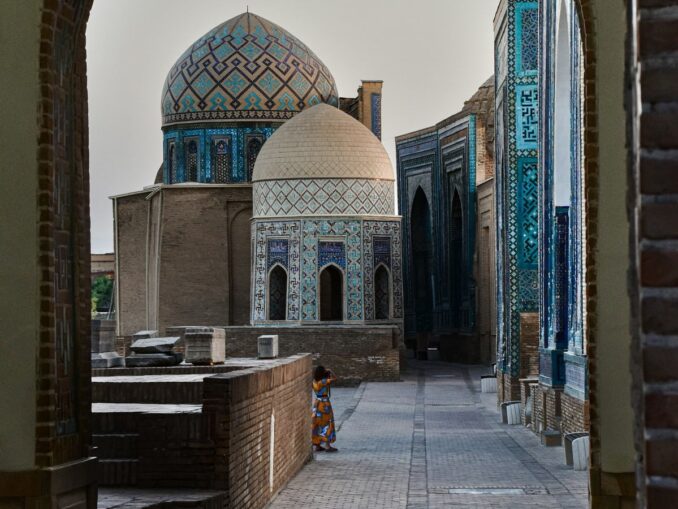
The architecture of the entire complex follows a unified portal-and-dome composition. Most buildings have similar facade decoration and use a similar color palette.
As a result, the single- and double-domed mausoleums of Shah-i-Zinda, built in different centuries, form an exceptionally harmonious ensemble
Afrosiab
A vast hilly wasteland on the northern outskirts of Samarkand is all that remains of the original city, destroyed by Genghis Khan. The ruins, where no one ever settled again, were named after one of the mythical kings.
At the Samarkand History Museum near the ancient settlement, you will learn what Afrosiab looked like in the distant past. You will also see frescoes and other historical finds discovered by archaeologists.
Then be sure to take a walk through the hills. From the top of these walls, once built of mud bricks and now turned back into simple clay, you can enjoy an impressive panorama of the modern city.
Here’s why it’s better to travel from Tashkent to Samarkand by Afrosiyob train.
Ulugh Beg Observatory
To determine the precise positions of celestial bodies, the mathematician and statesman Ulugh Beg built an observatory near Samarkand. This unique 15th-century structure housed measuring instruments that made it possible to calculate the coordinates of stars accurately at any point on the celestial sphere.
Working with these instruments, Ulugh Beg compiled a star catalog describing more than a thousand stars. Today, a museum has been opened near the observatory.
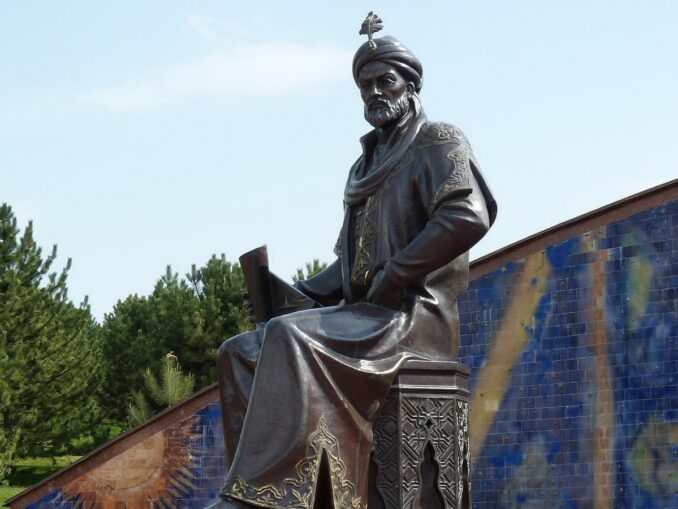
Its exhibits include photographs from the excavation site, as well as instruments discovered at the observatory and astronomical tables. A monument to Ulugh Beg himself, a truly extraordinary figure, has been erected beside the museum.
Mausoleum of Saint Daniel
Legend has it that on one of his campaigns, Tamerlane brought back the relics of the Old Testament prophet Daniel and ordered them buried on a hill in Afrosiab near the banks of the Siab River. A long black tomb inscribed with golden Arabic calligraphy stands over the burial site.
According to legend, the spirit of Saint Daniel (Daniyar) watches over Samarkand. Interestingly, representatives of three world religions come here to pray: Christianity, Islam, and Judaism.
A small park has been laid out on the riverbank, with a holy spring. According to local beliefs, water from the spring can cure many illnesses.
The story of the centuries-old pistachio tree growing near the crypt is equally remarkable. It had dried up, but came back to life after Patriarch Alexy II blessed it during his visit to the Khodja Doniyor mausoleum.
Ruhabad Mausoleum
If the sights listed above are not enough for you and you continue exploring the question of «what is worth seeing in Samarkand», we also recommend paying attention to this memorial complex. It was built in honor of the preacher Burhaneddin Sagarji, Tamerlane’s spiritual teacher.
Compared with the magnificent Gur-e-Amir, Ruhabad may seem less impressive.
But that was precisely what its builders intended. They wanted to demonstrate the supremacy of spiritual values over the luxury of power.
The chronicles mention that Tamerlane himself would always dismount and walk past the mausoleum on foot.
Shakhrisabz
As for Shakhrisabz, a small town located 80 km from Samarkand, you can read an excellent detailed review of a visit there here — otzyv.ru/review/159432/.
We, however, recommend that you don’t try to organize everything yourself! And instead visit Tamerlane’s birthplace — which also happens to be a site that has earned its own entry on the UNESCO World Heritage List — with a guided tour!
© Eurotraveler