What to see in Pisa in Italy in 1–2 days on your own, and where should you go first? Main attractions and interesting places, a convenience walking route (you may follow), nice and affordable accommodation to stay overnight… How do you get from the airport, where to visit near Pisa and go for a seaside break — all this in a slightly rambling but practically minded guide from Eurotraveler.
Tuscany is probably Italy’s most beloved region among travelers. Although, by giving you a trouble to sort it out, you will deliberately find that not the whole region is equally popular.
For most visitors tend to focus on Florence itself. As well as — maybe — on the vineyards and small towns included in tours from the Tuscany’s capital!
Well, perhaps, deserves a mention the Leaning Tower of Pisa also. It has been leaning for ages, practically since birth, and has become so famous that it has helped fuel a widespread misconception: that Pisa, the city it leans over, can be in just one day!
Yes, that is exactly what most travelers think. And there is little point in blaming them: at first glance, the Tuscan city seems to have very few famous sights.
- We have already mentioned the Leaning Tower of Pisa above. And should add, though, that it is not just a tower but an actual bell tower attached to the local Duomo
- The cathedral itself is less well known, as it sits in the shadow of Pisa’s main “wonder”. However, it is absolutely magnificent!
What Else?
Nine out of ten tourists, even those who have visited Italy before, would struggle to answer that question. Or they would mumble something vague about Pisa’s old town, which is “wonderfully beautiful”.
Well, but we decided to investigate the matter thoroughly. Just because we refused to believe that an Italian city of a decent size can offer travelers only a couple of noteworthy sights.
So we put together a walking route that will help you to see in Pisa much more. We even tested it ourselves to make sure we hadn’t missed anything important!
Where to Go in Pisa
first of all? Especially when you bear in mind that there might not be a “second round” — for example, if you are visiting the city for just one day.
The answer is obvious and straightforward: if this is your first time in Pisa, start by visiting its famous tower.
We will not go into the history or current condition of the Leaning Tower of Pisa, which no longer falls but simply tilts. Instead, we’ll just point out that:
- this structure is world-famous,
- and climbing the Leaning Tower is still perfectly possible today without putting your life at any particular risk.
The bell tower stopped its dangerous movement toward the ground long ago, thanks to modern reinforcement of its medieval foundations. We have written a little more about the Leaning Tower of Pisa here.
A ticket for the cathedral and tower costs €20 (cathedral admission is included), and the visit lasts no more than half an hour — other tourists want to see Pisa’s main attraction, too.
No more than 40 people can be on the tower at any one time. For all the other details, it is best to check the official website: www.opapisa.it/en/tickets/prices/.
Duomo and Baptistery
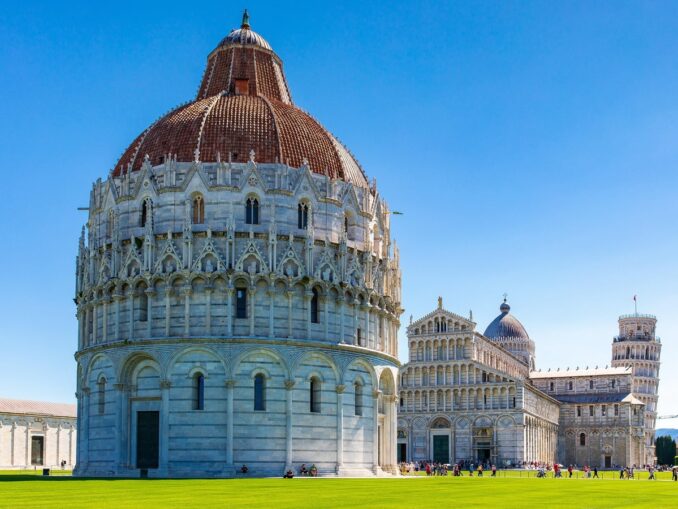
The Cathedral of the Assumption of the Virgin Mary is the most imposing building in Pisa. Art historians consider it one of the finest examples of Romanesque architecture in Italy.
Construction began in the 11th century, when Pisa was a powerful trading republic. Just look at the scale of the building and the sheer amount of marble used, and you will get an idea of how much money was invested in it.
Admission to the cathedral and its museum, which houses everything that could not fit inside the church itself, costs just €8.
- The Baptistery, a distinctive round building with a red-tiled roof, and the Camposanto Monumentale are two more must-see attractions in Pisa
- Both are located in Piazza dei Miracoli — the Square of Miracles.
Galileo Galilei was among those baptized in the Baptistery. Camposanto, or “Holy Field,” was essentially a mausoleum for Pisa’s prominent citizens.
The soil used there was brought directly from Golgotha in Palestine during the First Crusade. Just to put that into perspective, this was right at the end of the 11th century…
They say that to truly experience Pisa’s extraordinary atmosphere, you need to spend a good while lying on the green grass of Piazza dei Miracoli, gazing up at the blue sky above the white cathedral and tower.
Reflecting on life… or, more accurately, just lying there. Thoughts seem to stop coming, and you simply feel light and wonderfully at ease!
The National Museum of San Matteo
at Piazza San Matteo, 2, housed in a former Benedictine convent, will not appeal to every traveler (to be perfectly honest, it hardly seems to attract anyone at all). Yet it is definitely worth visiting in Pisa!
Especially, if you want to immerse yourself in the world and experiences of artists who lived and worked in the dark, distant Middle Ages. Enjoying a little peace and quiet along the way…
- Halls of the San Matteo Museum display paintings and sculptures, mostly by lesser-known Tuscan artists
- The Madonna del Latte statue from the Church of Santa Maria della Spina is undoubtedly one of the collection’s highlights.
Still, while the museum is more for enthusiasts and people with a particularly sensitive, artistic soul, everyone should make time to see the elegant
Church of Santa Maria della Spina in Pisa
It looks like an actual jewel box, and the best part is that this fascinating example of Gothic architecture is built right into the banks of the Arno River (Lungarno Gambacorti).
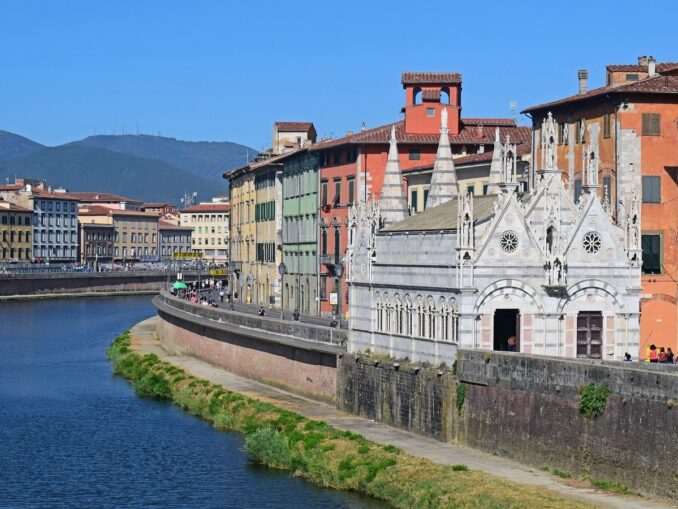
White and pink marble covering the church’s facades stands out beautifully against the ochre-colored walls of the neighboring buildings.
As for the name it was received thanks to a rare relic owed in the 14th century: a thorn from Christ’s Crown of Thorns
The church was rebuilt on its present site in 1871. The original building was first dismantled and then moved, quite literally brick by brick, to higher ground where the risk of flooding was much lower. Floods on the Arno can be truly devastating.
- During the relocation, every effort was made to preserve the original church’s exterior and interior appearance.
- Most of the statues, both inside and outside, are high-quality replicas.
The original examples of medieval art are now kept in the city’s National Museum, which we mentioned above.
Where to Stay Overnight
First, let us point out that you can find a hotel room or even an entire apartment in Pisa for not just a reasonable price but a very attractive one by today’s standards: around €100–110 per night, plus a small local tourist tax. And our clear favorite in the city is Villa Magnolia Park.
Which is representing a beautiful old house having spacious rooms with high ceilings. Delicious breakfasts, welcoming hosts, free private parking — all this is hard to ignore.
And yes, it is just a 10-minute walk from the Square of Miracles and the Leaning Tower!
Day 2
As you may have guessed from the previous section, you should plan to stay at least one night if you want to see all of Pisa’s interesting sights. Otherwise, you will be utterly exhausted and probably too tired to enjoy much by the evening.
In addition to the attractions listed above, the city is home to several more sights worth visiting, including:
Palazzo della Carovana
This imposing 16th-century building on Piazza dei Cavalieri (Knights’ Square) was built during the Medici era. Its walls are decorated using the relatively rare sgraffito technique. The architect and artist behind the project was the famous Florentine Giorgio Vasari.
- He completely redesigned the famous Palazzo Vecchio in Florence (we have written about it in detail here, and even included an excellent video) and designed the famous Vasari Corridor, which the Medici family used to walk to work every day…
- Vasari also wrote The Lives, a collection of biographies of Italy’s most famous painters, sculptors, and architects.
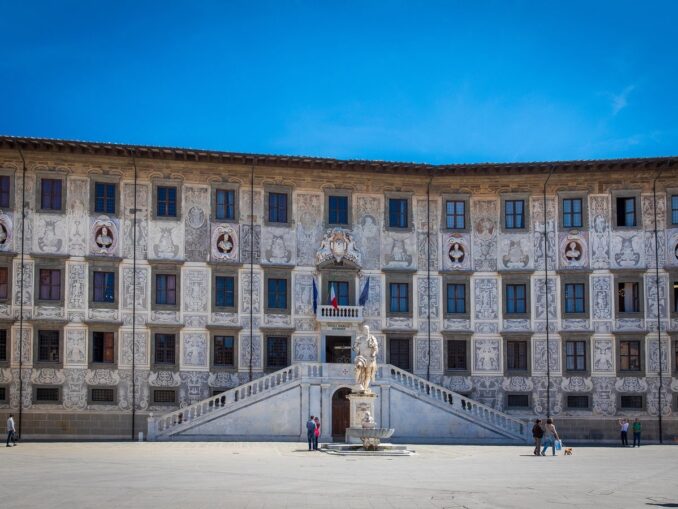
Palazzo della Carovana was built for the knights of the Order of Saint Stephen. Today, it houses the prestigious Scuola Normale Superiore, founded by Napoleon Bonaparte in 1810. Its alumni include the physicist Enrico Fermi.
Nearby is
The Church of Santo Stefano
which catches the eye with its simple yet stunning marble facade. The Clock Palace is also visually striking and quite unusual. Through its archway, you can glimpse the charming little Via Dalmazia.
The Botanical Garden of Pisa
has every right to call itself the oldest botanical garden still in existence, having been founded in 1543. It covers a relatively modest area of 3 hectares and is run by the local university, but there are plenty of reasons to visit.
Adult admission costs €4: www.ortomuseobot.sma.unipi.it/tariffe.
Pisa has also preserved a substantial stretch of its ancient city walls, along with four towers. You can access the walls at four different points, with the most convenient entrance near Piazza dei Miracoli.
An adult ticket costs €5: www.muradipisa.it/organizza-la-tua-visita/#orari.
Beach Holidays
Pisa was once a great maritime power. Over time, the city ceased to be a port, and natural forces gradually pushed it farther away from the coast.
To be fair, the sea itself is what moved away
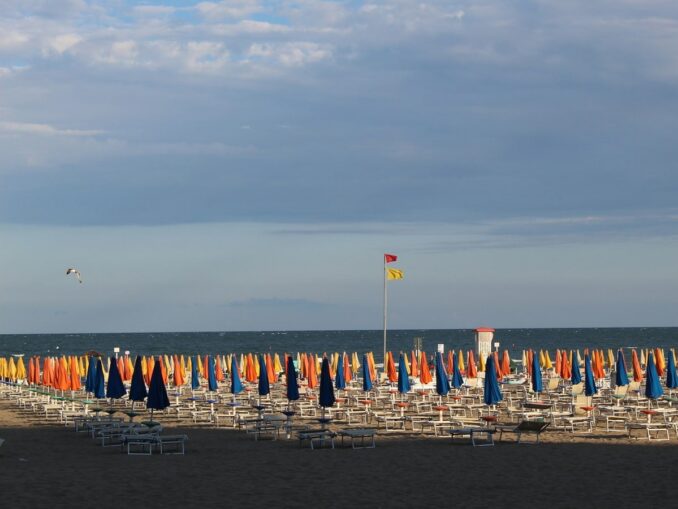
So these days, locals and tourists have to travel rather than walk if they want to swim or sunbathe. Popular options include Marina di Pisa and Tirrenia. Unfortunately, neither has yet made it onto the list of Italy’s best-known seaside destinations.
Marina di Pisa is a pleasant seaside town, but its shoreline is mostly pebbles and rocks. On the plus side, there are free beaches.
You can find a good hotel in Marina di Pisa here.
Tirrenia is more of a resort village than a town, and its beaches are sandy. However, if you want to relax on the local beaches, you will need to rent a sun lounger and a beach umbrella (hotels and apartments in Tirrenia).
You can get from Pisa to the coast by local bus or car. The journey takes no more than 20–30 minutes.
How to Get to Pisa and Where to Go Next
For some travelers, Pisa is the first stop on their Italian trip, a kind of starting point. As mentioned earlier, this is because several low-cost airlines operate flights into the city’s Galileo Galilei International Airport.
Getting from the airport to Pisa itself takes very little effort.
In short, you just need to use the PisaMover service (pisa-mover.com/en/).
- This automated people mover runs every 5–8 minutes between 6 a.m. and midnight.
- It takes just 5–6 minutes to get from the airport to Pisa Centrale railway station.
Those having no plans to visit Pisa itself (perhaps they have been there before), may head straight from Galileo Galilei Airport to Florence. As from there it is so easy to start exploring Tuscany and… the rest of Italy.
If you have an “extra” day or two, you should definitely visit Siena. Travelers having more time, may head off to explore the sights of Rome.
After all, you can get from Florence to Italy’s capital by train in just over an hour! Is not that a good enough reason to broaden horizons?
- Where to Go in Florence on Your First Visit
- Best Souvenirs and Food to Buy in Italy
- What Foreigners Should Watch Out for in Italy
© Eurotraveler