What to see in Florence in 1–2 or 3 days on your own? The main attractions and interesting places, a convenience walking route, some fun acts about the city. Where is better to stay overnight, and go first in Florence with children, what to visit in the surrounding area — Eurotraveler has all the details.
Florence is full of attractions and iconic places — no wonder it is unofficially known as the «Cradle of the Renaissance». It is no coincidence that the city consistently ranks among Italy’s three most popular tourist destinations.
So, to avoid getting exhausted by everywhere crowds and make sure you see at least the main sights in Florence, it is important to decide which attractions you want to visit much — before a trip. And then just stick to your plan.
Otherwise, your feet may take you off in an entirely unexpected direction. And by evening, you may find yourself surprised to discover that you have spent ages daydreaming on the banks of the Arno. Or wandering around a church cloister — in one of those look like a story from the «good old days».
Not sure you can put together a sightseeing itinerary by your own? Then you may join a guided tour in Florence — or even — several ones?! They’re not particularly expensive here, and often packed with loads of useful information.
And, by the way, don’t forget to deliberately lose yourself in the Tuscan capital. That’s when you’ll discover all sorts of places that even the most disciplined tourist never gets to see!
Interesting Places Of Florence
The most common way to visit the «Flower of Tuscany» today is by spending here 1 or 2 days. Then — after soaking up as many impressions as possible — modern travelers usually hop on a train.
To head off to explore Milan, spend a few days in Rome or Venice, or, of course, make their way to one of Italy’s seaside resorts. For instance, to Viareggio, Tuscany’s main beach resort!
It’s hardly surprising that travelers tend to sweep through Florence and Italy as a whole. As holidaying time are strongly limited now, while attractions in this boot-shaped country are quite literally everywhere you turn.
Still, we’d advise you not to rush. To get the most out of your visit, take your time seeing Florence!
So
the first thing you should do, whether you arrive in Florence by train or by plane, is head to Piazza della Signoria. And do you know why we’re suggesting you go there rather than heading straight to the Duomo?
Because the city’s cathedral usually tops the list of must-see places in Florence in any guidebooks! As a result, the square in front of it gets wholly packed in the mornings. And the queues to get inside (admission is free) can be so enormous that just looking at them might be enough to make a faint-hearted visitor feel queasy.
One way or another, though, you’ll almost certainly have to make your way along crowded streets. After all, even in November Florence attracts plenty of tourists!
And during your strolls around the city, you’ll often find yourself stepping into the road. That’s because the sidewalks are full of people who are so mesmerized by everything around that they’re liable to walk straight into you…
Piazza della Signoria
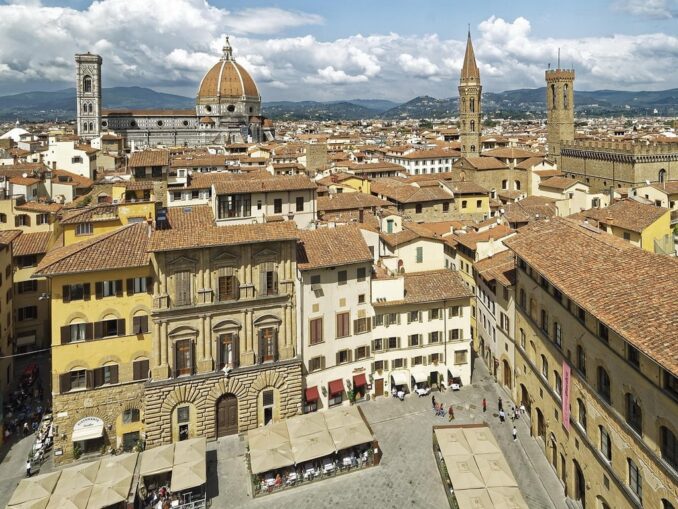
is beautiful in its own right. But its main attraction is the imposing Palazzo Vecchio (the «Old Palace»).
Of course, it wasn’t old always. Back in the day, it was new, while the Bargello Palace was considered the old castle.
And the good news is that Bargello has survived, too. So, we’ll recommend visiting it in Florence as well — just a little later.
Apart from the magnificent Duomo, the Renaissance-style Palazzo Vecchio is arguably the city’s greatest architectural treasure. It’s well worth taking a close look at both its exterior and interior.
But first, take a look around Piazza della Signoria. Admire the equestrian statue of Cosimo I, founder of the formidable Medici dynasty, walk around the Fountain of Neptune. Peer over the tourists’ heads to admire the white-marble statue of David, created by the incomparable Michelangelo…
Don’t spend too long admiring it — this is a copy. To protect the original, it now stands in the main hall of the Galleria dell’Accademia in Florence!
The fact that the Palazzo Vecchio still houses the offices of the modern city government won’t stop you from exploring the heart of Florentine power, the former residence of the mighty Medici family. In the mid-16th century, however, they moved to Palazzo Pitti, across the river from the center of Florence’s public life.
According to Legend,
Eleonora di Toledo told her husband, Cosimo de’ Medici, quite bluntly that it was beneath the Grand Dukes of Tuscany to live in some sort of fortress. So the prominent banking family took the opportunity to buy the residence of their bitterest rivals on the other side of the river.
A guided tour of Palazzo Vecchio’s rooms can easily take up half a day. Even if you explore it on your own, you’ll probably need at least two hours.
You don’t necessarily need an audio guide, as the rooms have information panels in English. Still, a guide in your native language would be helpful — it can give you a much deeper understanding of the history and atmosphere of this historic palace.
More information can be found at cultura.comune.fi.it/pagina/musei-civici-fiorentini/museo-di-palazzo-vecchio.
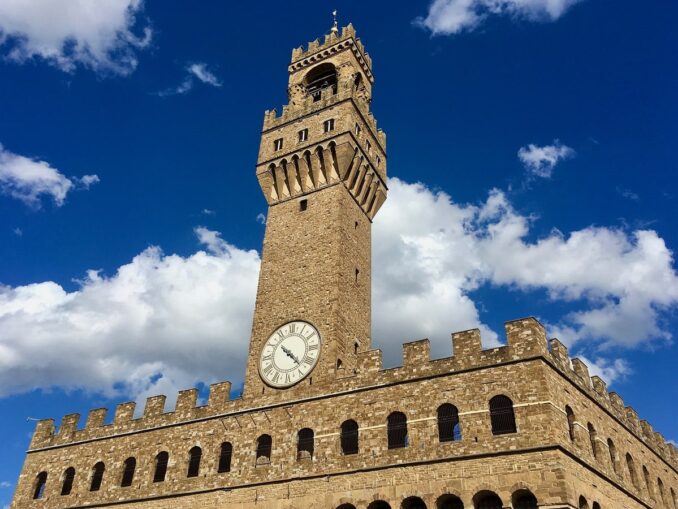
A must-do experience inside is climbing the famous Torre di Arnolfo, which stands an impressive 95 meters tall!
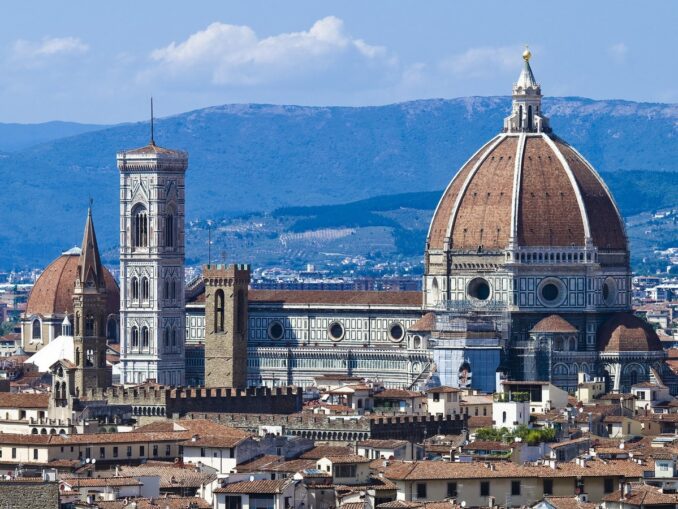
From the observation platform at the top, you’ll enjoy breathtaking views over the city’s terracotta rooftops and another famous Florence sighit — Santa Maria del Fiore Cathedral…
Once you’ve left the Medici residence, don’t forget to admire
Loggia dei Lanzi
which is filled with sculptures by great masters.
The bronze Perseus holding the head of Medusa is the original masterpiece by the incomparable Benvenuto Cellini. The other sculptures you can see in the loggia are copies.
The originals, meanwhile, are once again housed in the city’s Galleria dell’Accademia.
Next, of course, you’ll want to visit Florence’s famous museum:
Uffizi Gallery
Tour guides rightly point out that you’ll need at least two to three hours to explore its collections properly! You may also have to spend some time waiting to get in — even during the off-season, there are plenty of visitors.
If you’re not particularly familiar with art, exploring the gallery with a guide will probably be easier. Who’ll introduce you to the Uffizi’s greatest masterpieces, including Caravaggio’s «Medusa» and Botticelli’s «The Birth of Venus». And might also draw your attention to lesser-known but absolutely stunning paintings and sculptures!
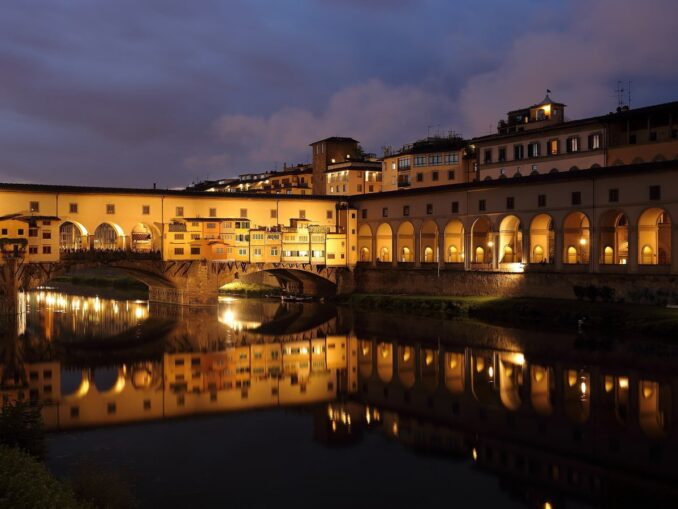
Afterward, head down to the Arno waterfront and look for the Vasari Corridor. Find a good spot to photograph Ponte Vecchio, then walk across the bridge itself.
And… that’s quite enough for your first day exploring Florence! Besides, there’s no guarantee you’ll manage to fit all this into just a few hours.
It’s worth noting that the distinctly medieval
Ponte Vecchio
is another of the Tuscan capital’s most characterful attractions. It’s best admired from a little distance. After all, tourists occupy practically every square meter of the bridge spanning the Arno…
Where to Stay Overnight
We recommend looking for a hotel or apartment outside the very heart of Florence.
- For one thing, accommodation there is much more expensive
- For another, you’ll have little peace and quiet amid the huge, noisy tourist crowds.
A better option is to stay on the other side of Piazza della Signoria, perhaps near Santa Croce Basilica. One of our favorite picks there is Uffizi Harmony, a comfortable hotel. Which — what a pity — not exactly cheap.
If you’re watching your budget — or simply don’t like throwing money around — consider the more affordable but still very decent and well-located Hotel Dali.
Experienced travelers often choose to stay on the other side of Piazza della Signoria, near Florence’s main railway station, Santa Maria Novella.
This way, you can stay close to the action (the cathedral is only a five- to seven-minute walk from the station) without making Florence the sole focus of your trip. And take a day trip to Siena or to Pisa.
Here’s what else is worth seeing in Tuscany besides Florence.
Day 2
The next day you may start where you began the first one — at Piazza della Signoria. Then walk past the Uffizi, make your way down to Arno, and follow roughly the route taken by Medici toward Ponte Vecchio.
You can follow this route through the covered Vasari Corridor, which now houses an art gallery (admission is charged). But simply walking along the riverbank and crossing the bridge is quicker and cheaper!
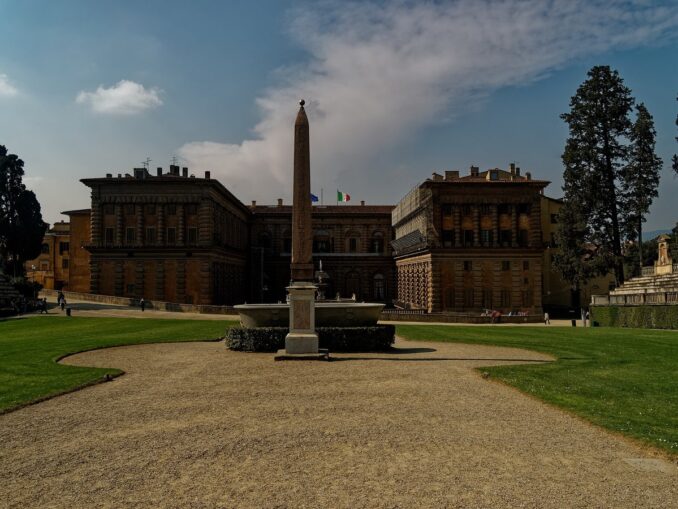
Get up early, and you can watch the sun rise over Florence. Otherwise, simply cross the bridge and head straight for Palazzo Pitti and the Boboli Gardens behind it.
This is another major local attraction and, in our opinion, one of the highlights of the city.
Visiting the Pitti Gallery
is best planned for early morning. The gallery opens at 9 o’clock (9 a.m.), and by 10 or 11 a.m. there’s usually a substantial queue at the entrance.
Assume you’ll spend at least half a day inside, whether you have a guide or explore independently. After all, the gallery displays no fewer than 11 paintings by the incomparable Raphael alone.
The palace itself is considered a masterpiece of Quattrocento architecture. That’s true of its exterior — much of the interior was remodeled in the 19th century in a rather bland, albeit lavish, style. Understandably so, since the Grand Dukes of Tuscany lived at Pitti for centuries.
We also recommend visiting the Costume Gallery while you’re there, if it’s open (admission is included in the combined ticket; entry is free on the first Sunday of the month). Then take a stroll around the park.
Although the Boboli Gardens are neither particularly large nor especially lavish, they’re among Europe’s earliest examples of a formal garden.
If you decide to visit Florence in May, you’ll find magnificent peonies in bloom at Boboli. They’re a wonderful mood-booster, and their fragrance is intoxicating — although allergy sufferers should take care!
After visiting the art gallery, make your way to
Piazzale Michelangelo
It’s not an old square — in the days of the great sculptor, goats were probably grazing here — but it’s famous for its exceptional views over the city. Most of the panoramic photos of Florence that circulate online are taken from this very spot!
A perfect final point of your second day itinerary is Piazza del Duomo. Much of the square is occupied by the magnificent Santa Maria del Fiore Cathedral, whose sheer size — and perhaps grandeur — can be a little overwhelming.
Nearby stands Giotto’s Bell Tower, an exquisite, delicate-looking structure that’s a true jewel of the square and the city. You can climb to the top, too.
Day 3
You won’t run out of things to do. Even after two days of sightseeing, Florence will still have plenty of surprises in store!
Let’s mention Galleria dell’Accademia again, the home to Michelangelo’s original David. This museum is a little way from the historic center, but it’s one of the most popular in all of Italy!
We also strongly recommend visiting wonderful Basilica of Santa Croce. Its façade is decorated with a large six-pointed star, and the church is easy to spot from the observation platform atop Torre di Arnolfo, for example.
Inside, Santa Croce is adorned with magnificent frescoes by Giotto. It also houses the tombs of Italian giants such as Michelangelo, Machiavelli, Rossini, and Fermi, as well as Dante’s cenotaph.
Dante, the great Italian poet born in Florence, was an outspoken opponent of the popes during his lifetime. He escaped execution only by fleeing the city.
He eventually settled in Ravenna, where he died. And despite repeated requests, Ravenna never returned the poet’s remains to Florence.
Other places worth checking out in Florence
Include:
- Medici Chapels in the Basilica of San Lorenzo. Unassuming on the outside, the chapels are decorated inside with magnificent sculptures by Michelangelo. In terms of expressive power, only the Pietà in the Vatican can rival the figures of Dawn and Dusk reclining on the tombs of members of this powerful Florentine family.
- the Bargello Palace. Once the residence of the city’s chief magistrates, it has since been turned into a museum. It houses outstanding sculptures by Donatello and Michelangelo, along with a fine collection of medieval art.
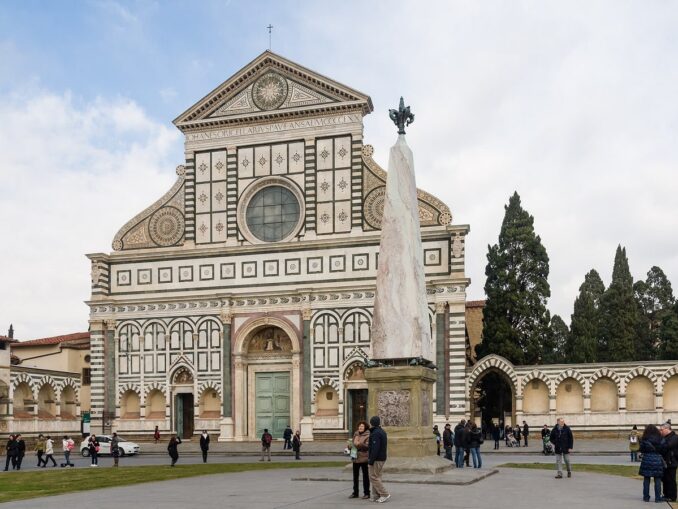
- the Church of Santa Maria Novella, located directly opposite Florence’s main railway station. The church faces away from the station, but its main façade is one of the earliest examples of Renaissance architecture in Italy!
Where to Go with Children
Florence does have attractions specifically aimed at children, but they’re not particularly well known. Nor are they especially popular — tourists are usually so busy rushing around to see the main sights that they forget about the less famous ones.
However, if you want to treat your child to something special, visit Florence’s Toy Museum together. It opened relatively recently and is so conveniently located (near the Duomo, at Via dell’Oriuolo 47) that it would be a shame not to pop in.
Inside, you’ll find a private collection of children’s toys, with almost half the collection devoted to the famous Pinocchio. Visit museodelgiocattolo.it. Judging by the reviews, the museum’s owner is a real expert on all things Pinocchio.
We also recommend that visitors with children check out Florence’s Stibbert Museum. This remarkable collection of several thousand objects is displayed in the rooms of a genuine aristocratic villa on the outskirts of the city. Find more information at museostibbert.it/frontend/index.php.
Its greatest treasure is its outstanding collection of armor and weapons. In one of the rooms, you can even see an entire squad of knights dressed in full armor.
Getting to the Stibbert Museum from Florence’s main railway station, Santa Maria Novella, is easy — the tram ride takes just half an hour. And the vivid impressions you’ll take away will more than make up for the journey!
Day Trips from Florence
You may want to take a journey to other towns in Tuscany. Trains run regularly, and the distances are laughably short by the standards of seasoned travelers.
You could even make it to Perugia (about 150 km away), a city that has preserved several monuments from the Etruscan era.
But first, every traveler should visit Pisa, with its cathedral and famous Leaning Tower. The train journey there from Florence takes only about 50 minutes each way.
You may also to stop by Lucca, the hometown of the soulful composer Giacomo Puccini. Or head to the coast for a swim at the upscale seaside resort of Viareggio, which we’ve already mentioned?
Why not? Other travelers deliberately stay on the Tuscan seashore for a week or two!
Of course, Siena deserves a place on your itinerary, too. In fact, one day may not be enough to explore it properly.
A wonderful option for a half-day trip is the small town of San Gimignano. Also known as the «Town of 14 Towers,» it is an UNESCO-protected site. And you’ll understand why as soon as you step inside its ring of medieval walls…
How to Get There
Low-cost airlines tend to use airports in Pisa or Verona, both outside the Tuscan capital, as their hubs, so you’ll need to travel onward from there. Fortunately, that’s not difficult: you can get from Pisa Airport to Florence on a direct shuttle bus. The same is true of Verona, by the way!
Many tourists also arrive in Florence by car, traveling from Austria and Germany, France or Slovenia, and Croatia. Depending on where you’re coming from, the journey can take anywhere from a few hours to a couple of days.
And, of course, driving around Italy is a pretty easy way to explore, as the country has plenty of toll highways. The only downside is that the local tolls can be rather expensive.
- The fastest way to get from Florence to Rome
- Unique things worth buying in Italy
- What to see in Montalcino, Tuscany
© Eurotraveler