What to see in Siena in 1 day or more? Main attractions and interesting sights of Italian city, walking routes, where to stay overnight? Where should you go first in Siena, what is worth visiting nearby, how do you get there independently from Florence and Rome? Eurotraveler has all the answers.
In Siena, a big by Tuscan standards and a remarkably beautiful city, travelers rarely spend much time. Usually they set aside just one day — two at most — to explore the heritage of rich trading republic.
Even foreign visitors traveling around Italy by car — people who like to be «masters of their own itinerary» — are reluctant to spend more time in some kind of «provincial backwater.»
Especially when their plans include several days of sightseeing in Rome, visits to Milan and Venice. And, of course, Florence, which is practically next door to Siena!
And that’s unfair!
- As you may well manage to see in Siena its main attractions in a day.
- But soaking up the spirit of the city, truly appreciating how beautiful it is in such a short time is practically impossible!
Keep in Mind
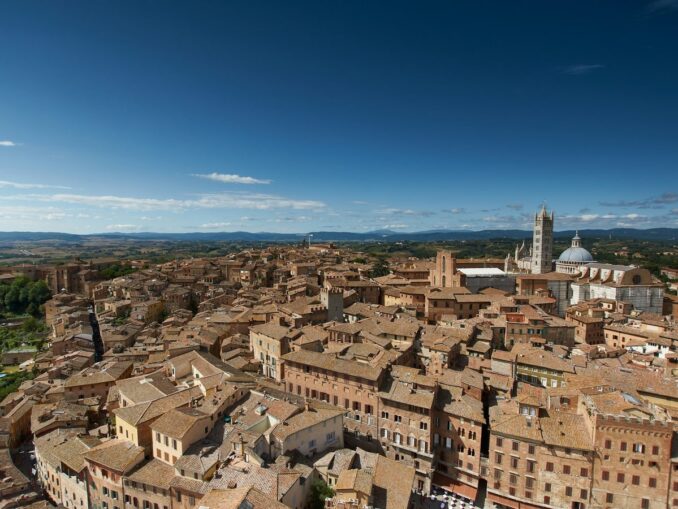
Siena was once a powerful republic, a formidable rival to Florence and leading center of banking in Europe. Original churches, houses, and palaces were built here, while art and trade flourished.
Today, however, this Tuscan city exists in something of a tourist bubble. In a way, that’s worked in its favor, allowing it to preserve a wealth of buildings in almost their original condition, along with its wonderfully peaceful, old-world atmosphere.
So rest assured, you’ll definitely find plenty to see and do in Siena over two days — or even longer. In fact, you may well want to stay here for a week or two!
- After all, Siena has a remarkable way of healing emotional wounds and restoring your energy, no less effectively than an exclusive wellness retreat.
- And the prices at local family-run hotels and apartments… are considerably lower than in Florence!
But before we begin our guide to Siena’s most interesting sights, here’s an useful tip. About how to
Reach the Old Town Quickly
when you get off the train?
Siena is built on hills. So if you want to get from the railway station to the old town, for example, be prepared for quite a climb.
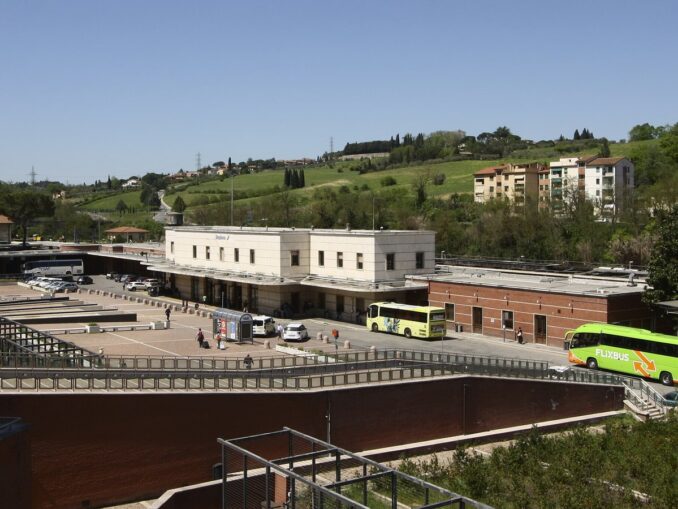
Or simply know that the city has long had a moving walkway to make life easier for visitors. It’s free and takes you both uphill and back down again.
So, straight from the station, head for the moving walkway — a four-section escalator tucked away inside the station’s shopping complex. It’ll take you to the top of the hill. Trying to walk uphill through the streets the whole way will leave you exhausted.
From the upper exit of the moving walkway to Porta Camollia, the gateway to Siena’s old town, it’s less than a 5-minute walk!
To Find the Walkway:
- Leave the station and head toward the shopping center.
- Then take the elevator (or stairs) to the third floor.
- There you’ll find the much-needed moving steps, which will take you «where you need to be» in 5–7 minutes.
At the top, exit, turn left, and follow a pleasant, tree-shaded street. After 2–3 minutes, you’ll reach an old archway at a three-way intersection. That’s Porta Camollia.
This is the ancient gateway you’ve been looking for — beyond it lie all of Siena’s most interesting sights!
On your way to the old town, cross to the other side of the street and treat yourself to some incredibly delicious Italian gelato. There’s a street kiosk selling it right there.
Siena’s Best Attractions
You can find lists of Siena’s sights on hundreds of websites. But we have our own ideas about where to go first — and what to save for later!
First, here’s a tip: don’t walk past the old churches. They’re everywhere, and most don’t charge an entrance fee — this isn’t Venice! If you see an open door, step inside and take your time.
The churches in Siena that don’t get much attention in guidebooks are usually almost empty, if they have any visitors at all. What they do have is a wonderful, soothing atmosphere — a kind of spirit of place that you’ll probably only encounter in Italy, a country that still deeply respects its longstanding traditions.
Sometimes, this can be inconvenient for foreigners. Here, you can read about some interesting customs in Italy that may either delight or… drive you crazy!)
Rows of wooden pews, centuries-old Gothic pointed arches, sunlight gilding the walls — it’s all worth an extra 10–20 minutes of your time.
A statue of the Madonna, Christ on the cross above the altar, candles flickering softly — nothing and no one will disturb you as you talk to God and look within yourself. And when you step back outside, you’ll feel a little different, a little more at peace with yourself…
Another memorable sight on the way to Siena’s center is
Palazzo Salimbeni,
standing in the square of the same name. This palace was the ancestral home of an influential local family before becoming the headquarters of a major local bank, Monte dei Paschi.
It’s considered the oldest bank in the world and, until recently, was one of the most influential in Italy. Its downfall came from an appetite for investing in residential real estate. The property crisis that hit in the early 21st century quickly turned its assets into unsecured and «bad» loans.
Now for the main event: in Siena, you absolutely must visit
Piazza del Campo,
the city’s central square. Unlike most «ordinary» squares, it’s not flat. Instead, it resembles a stone-paved amphitheater sloping down toward the center.
- Every year, on July 2 and August 16, Piazza del Campo hosts the famous Palio di Siena, bareback horse races.
- It’s a wonderful and extraordinary tradition that dates back to the depths of the Middle Ages.
Incidentally, it’s not just jockeys and horses competing in these races. The real rivals are Siena’s contrade — the city’s 17 historic districts, whose residents have had no need for centuries to settle the question of who’s best with fists or sticks.
At the base of Piazza del Campo stands the palace of the city’s (republican!) government,
Palazzo Pubblico
along with the tower whose bell once alerted residents to every important event: Torre del Mangia.
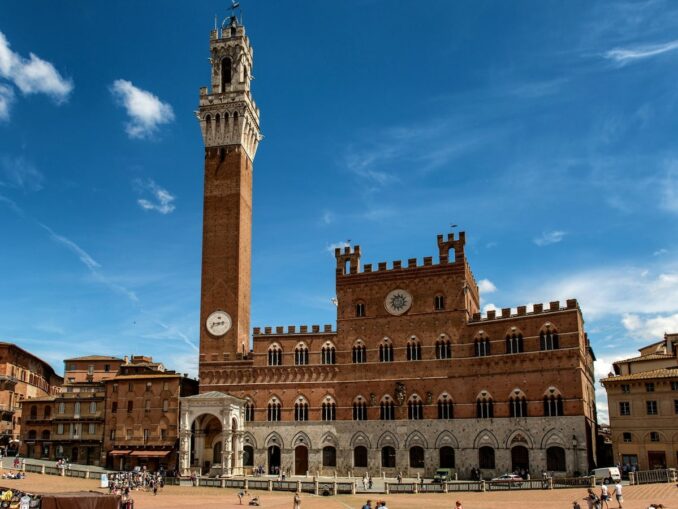
The palace was once the center of civic and republican government. Today, it houses a museum. Some original interiors and furniture have survived, along with 14th-century frescoes!
Admission is inexpensive, and families with children can save a few euros by purchasing a family ticket. Access to Torre del Mangia is sensibly excluded from the standard palace ticket, so you’ll need to buy a combined ticket if you want to climb the tower too.
It’s worth going inside Palazzo Publico, even if you’ve planned to spend as little time in Siena as possible.
- You’ll get a glimpse of how republican institutions operated in medieval Italy and can admire frescoes from the pre-Renaissance period.
Fonte Gaia
This fountain in Piazza del Campo is sure to catch any tourist’s eye. The «Fountain of Joy» is a rectangular basin and a beautiful example of the Quattrocento, or early Renaissance, dating to the beginning of the 15th century.
Of course, we’d recommend exploring the square with a guide. Besides the square itself, the tour will include plenty of other local sights.
You can also pick up something interesting here — you won’t forget to bring home some original souvenirs from Italy, will you? Just bear in mind that prices in the square tend to be a little higher than in other, less touristy parts of this Tuscan city.
Where to Eat
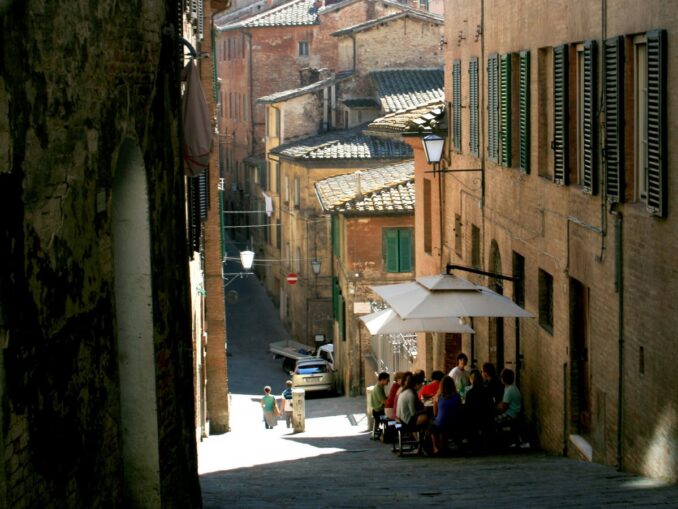
Next, it’s time to recharge with an authentic Italian dish — pasta, for example. There are plenty of places serving it in the little lanes around Piazza del Campo. But choose carefully! And whatever you do, don’t eat right on the square.
The surrounding streets are full of cafés and restaurants serving pasta and pizza made with homemade dough. There’s an easy way to judge a place: if the outdoor tables are occupied by Italians, go on in!
- A Margherita pizza costs from €7–8.
- Pasta of the kind you’ll never find in a supermarket costs about the same.
- Drinks start at around €5–6 for a bottle of water (1.5 liters) or a beer (0.5 liters).
In general, food prices in Italy are fairly reasonable — provided, of course, that you shop at supermarket chains rather than small local family-run stores.
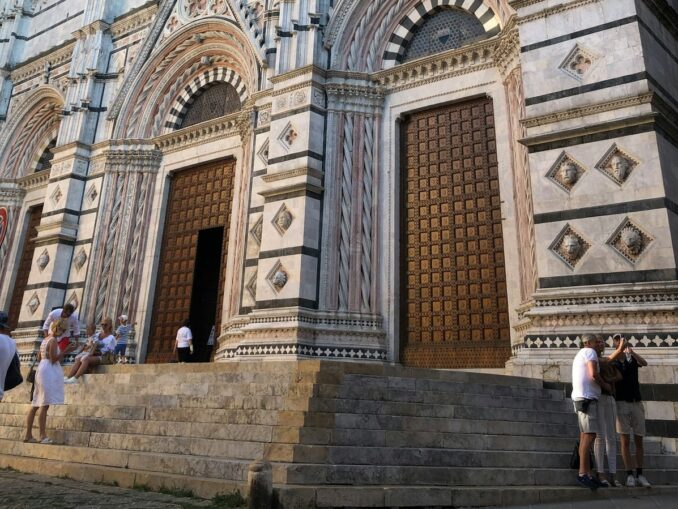
Siena Cathedral and the Piccolomini Library
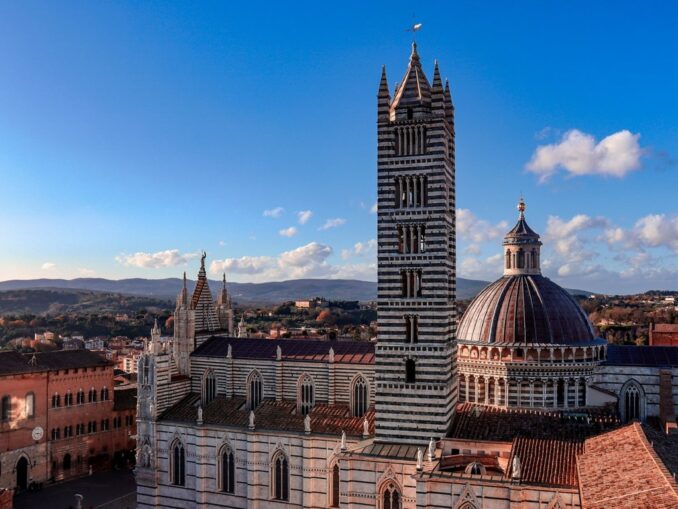
Once you’ve had a little rest, it’s time for a proper visit to Siena Cathedral. It’s absolutely stunning, with its exterior clad in white and pink marble, like a gigantic handcrafted jewelry box.
This architectural approach isn’t unique to Tuscany. Florence’s Santa Maria del Fiore, for example, is clad in white and green marble from its foundations to its roof.
- Inside, Siena Cathedral has a fascinating layout: its vaults are supported by clusters of four black-and-white columns — the city’s colors.
- On the right as you walk through the cathedral, there’s a doorway leading to the famous Piccolomini Library, covered in frescoes by Pinturicchio, whose name means «Little painter.»
On the left side of the central nave, you’ll find several chapels, including one dedicated to the city’s patron saint, Catherine of Siena.
Visiting the cathedral and library costs just a few euros, so even budget-conscious travelers won’t feel the need to skip them. You can find detailed information about the cathedral here: operaduomo.siena.it/en.
Basilica of San Domenico
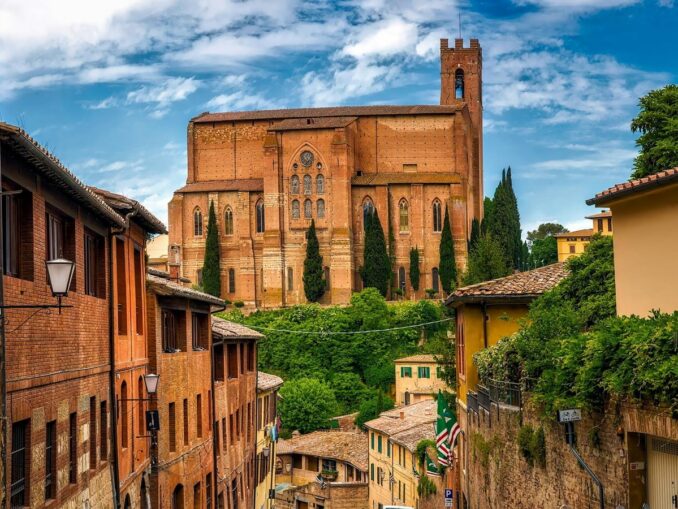
From the cathedral, we recommend walking to Basilica of San Domenico. Its simple yet imposing structure stands just a 7–8-minute walk from Piazza del Campo.
- This massive brick building has few architectural flourishes, yet its sheer scale and austerity make an enormous impression.
Inside, everything feels different from Siena Cathedral: there’s plenty of open space and very few columns. The ceiling seems to float high overhead, while candles quietly crackle in the little chapels around the altar. You’ll find especially many of them in the Chapel of Saint Catherine.
A 3–5-minute walk from the basilica brings you to the
Medici Fortress,
built according to the principles of military fortification. Its thick walls are impressive, and finding the entrance isn’t easy. So here’s a tip: if you’re coming from San Domenico, it’s on the right.
- There’s not much to see inside the fortress itself: just an open space where parades and military musters once took place, along with some beautiful fountains that no longer flow.
- Admission is free, and you can take a break on one of the benches…
From the top of the walls, you can gaze out over beautiful Siena and the Tuscan hills in the distance. Then head down and sit on a bench by the fountains for a while. It’s a lovely way to unwind after a busy day and enjoy some solitude — tourists rarely venture into this part of the city.
Where to Stay Overnight
Everything we’ve described so far suggests that Siena deserves more than a quick look. In our opinion, you should stay for more than just one night!
Travelers without their own car or a rental can, incidentally, afford to stay right in the old town. And compared with Florence, this can be a surprisingly affordable option: in the off-season, a double room costs less than €100 per night.
We recommend the family-run guesthouse Attilio Camere, located just 100 meters from Piazza del Campo. Its rooms are incredibly cozy and equipped with all the modern amenities you need!
- If you’re traveling by car, be sure also to stay at a hotel just outside Siena.
- This is unlikely to save much money, but it will reward you with an interesting experience of staying in the Tuscan countryside.
Bus connections to Siena are also quite good, by the way. Since many locals live in the surrounding suburbs and commute to the city for work.
Where to Go Nearby
If you’re not visiting during the Palio races on July 2 or August 16, you’ll be enchanted by the city’s indescribable atmosphere and wonderfully peaceful pace of life.
Siena is a city to wander around slowly. Soak up the atmosphere, enjoy incredibly delicious pasta in local restaurants, drink authentic Chianti, and eat your fill of gelato — it’s fantastic here!
Doing absolutely nothing can easily fill a day or two. And trust us, you’ll be reminiscing about this little chapter of your life and dreaming of coming back for a long time to come!
However,
you shouldn’t sink too deeply into nirvana just yet. After all, there are several incredibly romantic old basilicas near Siena, each of which is worth a visit.
Spending time in any one of them feels like a day at a wellness retreat — so soothing is their effect on a soul battered by the daily hustle and bustle.
One worth mentioning is the Basilica of the Osservanza, one of the area’s most impressive buildings, perched on a green hilltop. It’s best visited and photographed at dawn, when the rising sun bathes its brick walls in extraordinary colors.
You’ll obviously need your own car or a rental to get around. Distances are short, and you’ll have a wonderful opportunity to see Tuscany — the real, unspoiled Tuscany so often held up as the embodiment of «authentic Italy.»
This region is sunny and wonderfully welcoming, and even the most reserved person seems to come alive here. Tuscany is also the birthplace of such figures as Leonardo da Vinci and Michelangelo Buonarroti.
- If you’re heading north from Siena toward Florence, you can take a detour to explore San Gimignano, the «Town of 14 Towers».
- This remarkably well-preserved medieval town is a favorite with organized tour groups.
Getting there by train isn’t quite as straightforward — you’ll need to take a train and then a bus. But along the way, you can also explore the little railway town of Poggibonsi, which is absolutely charming in its unpretentious simplicity.
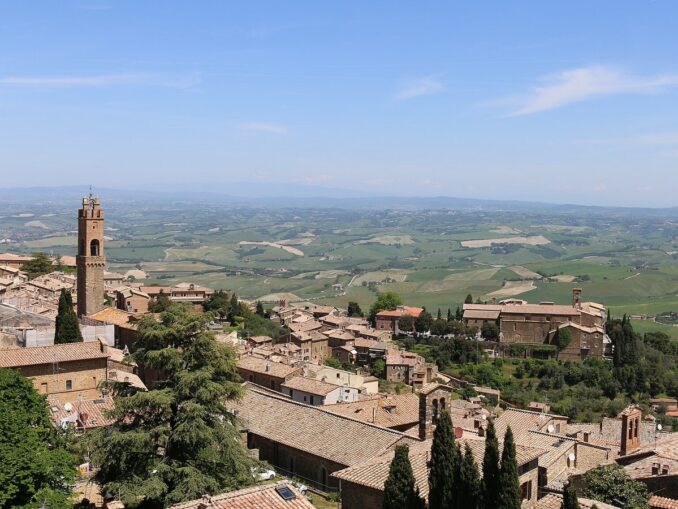
Less popular with travelers, or simply less well known, is the town of Montalcino, 40 km south of Siena. It’s where Brunello di Montalcino, one of Italy’s most expensive wines, is produced. The town itself is lovely, too, and definitely worth a visit!
How to Get There?
Most day-trippers arrive in Siena by train or bus, as these are the most convenient options. Driving is possible, too, but it’s best suited to enthusiastic road-trippers — the roads here are winding and steep.
- The train journey from Florence takes less than 1.5 hours.
At first glance, Siena’s railway station seems a long way from the city center, but in reality, it’ll take you no more than 15 minutes to get there. We explained exactly how to do it at the beginning of this article.
- A regular train from Rome takes almost four hours. No wonder, given that you’ll need to change trains twice, at Orte and Chiusi-Chianciano Terme!
The Frecciarossa high-speed train saves you about 30 minutes, but costs more. And, incidentally, it still goes via Florence. You can check schedules and fares here: trip.com/trains/italy/route/rome-to-siena/.
But the best way to travel from Rome to Siena is by bus! As it covers 230 kilometers of the distance in less than three hours, and a one-way ticket costs just €13–15.
- What to See in Florence in 3 Days
- What to See in Pisa Besides the Leaning Tower
- Is It Worth Traveling Around Italy by Car?
© Eurotraveler