How to Get from Prague to Vienna independently: by bus, train or car, which option should you choose? Distance, travel time, routes and prices in 2026. Plus, where to stay overnight and what to see in Vienna first hand — all covered by Eurotraveler.
Prague has long been more than just the capital of the Czech Republic. It is now one of Europe’s most popular tourist destinations. A real hit, if you will.
It’s one of those European cities that never gets old, even on your second or third visit. Every time you return to Prague, you somehow manage to discover something new and interesting.
And if you no longer feel like exploring, you can simply wander through the old streets, sit in a café and watch the sky change over the Vltava. Soak up the rich historical atmosphere and that wonderful sense of permanence and timelessness that seems to define the city.
What’s More,
Prague is also exceptionally well located. Almost as if it were deliberately placed there to make planning your next exciting and rather unconventional trip as easy as possible.
After all, you can take a day trip from Prague to somewhere else in the Czech Republic: Karlovy Vary, Český Krumlov or Brno, for example. Or venture a little farther afield: you can reach Dresden in Germany by train in around 2-2.5 hours.
Still, a trip from Prague to Vienna sounds even more promising! After all, it’s a fantastic opportunity to visit two first-class European capitals in a single trip.
- The distance between Prague and Vienna is approximately 250 km as the crow flies and around 330 km by road.
- In practice, travelling by bus or train takes around 4-5 hours each way.
So this kind of trip is perfectly doable. And you can plan the whole thing yourself, without any particular organisational headaches.
Let’s take a closer look at which means of transport is best, how much tickets cost and whether you can actually see Vienna in just one day.
By Bus
Perhaps the most obvious way to save money on a trip from Prague to Vienna is to take a bus.
Several operators serve this route, with FlixBus and RegioJet being the main ones worth considering.
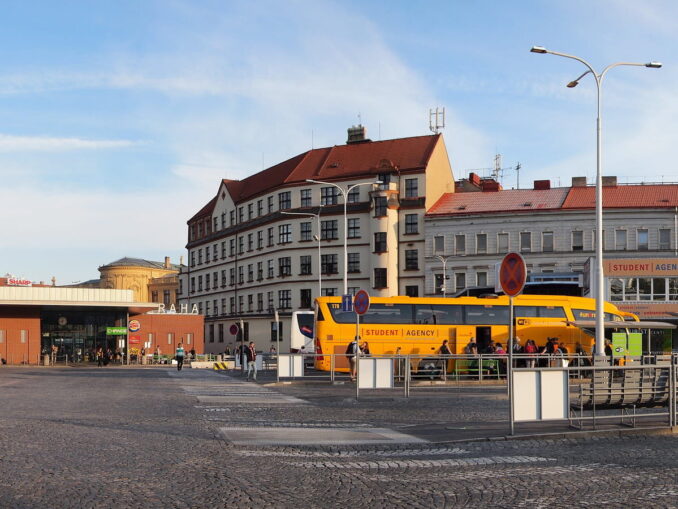
The journey takes approximately 4-5 hours. Some services cover the distance faster, while others take longer because of intermediate stops and traffic conditions.
Ticket prices depend on the date, departure time and how far in advance you book. As a rough guide, in 2026 you can expect to pay around €15-20 for a one-way ticket.
In Prague, buses usually depart from:
- ÚAN Florenc bus station,
- the main railway station,
- or other stops specified on your ticket.
In Vienna, they arrive at:
- Erdberg Bus Terminal,
- Vienna Central Station.
So make sure you check the departure and arrival addresses carefully: not all buses stop in the same part of the city.
A (fairly obvious) Practical Tip
Choose a service that arrives in Vienna in the morning and leaves in the evening (not necessarily on the same day, of course). That way, you’ll have as much time as possible to explore the Austrian capital.
And here is what you absolutely must see in Vienna.
By Train
If travelling by bus doesn’t sound comfortable enough, it’s worth considering the railway. You can get from Prague to Vienna on a direct train, including modern, comfortable services operated by Railjet and RegioJet.
The journey takes approximately 4 hours 10 minutes to 4 hours 30 minutes. Trains depart from Prague’s main railway station, Praha hlavní nádraží, and arrive mainly at Wien Hauptbahnhof in Vienna.
Depending on your travel date and departure time, you can find one-way tickets starting at around €15-25 if you book early. Buying a ticket shortly before departure will cost more.
You can purchase tickets directly from several operators:
- České dráhy (ČD) — cd.cz/.
- ÖBB — oebb.at/.
- RegioJet — regiojet.com/.
The advantage of travelling by train isn’t just comfort. You’re not at the mercy of traffic jams, so you can sit back, read a book, enjoy a coffee and admire the scenery along the way.

Of course, you can read and enjoy the scenery on a bus, too. But buses tend to offer a bumpier ride, as we all know. And there’s considerably less room to stretch out.
Another nice bonus is the location of the railway stations. In both Prague and Vienna, they’re close to the central districts and fully integrated into the city’s public transport network.
There’s also an online route planner available at wienerlinien.at/web/wl-en/plan-your-trip. You’ll also find practically all the information you need about public transport in Vienna on the same website.
By Car
Driving is a good option for those who like to be in control of their own schedule and don’t particularly fancy having to work around public transport timetables.
As mentioned earlier, Prague and Vienna are approximately 330 km apart by road. One of the main routes goes through Brno along the D1 and D2 motorways before continuing on Austria’s A5.
- Without any lengthy stops, the drive takes around 3 hours 45 minutes to 4 hours 30 minutes.
- Of course, a lot depends on traffic, roadworks and how busy the motorways are.
You can use viamichelin.com to plan your route and estimate the costs.
If you’re not driving your own car and plan to rent one in Prague, it’s quite straightforward. Car rental offices are available at Prague Airport, near the railway station and in the central districts.
You can compare offers here: discovercars.com/czech-republic/prague.
When renting a car, make sure to check whether you’re allowed to take it into Austria. Some rental companies impose restrictions, require advance notification or charge an additional fee.
How Much Will the Journey Cost?
Besides fuel, you’ll also need to factor in the cost of using toll motorways.
The Czech Republic uses an electronic motorway vignette. In 2026, the prices are:
- 1 day — 230 CZK;
- 10 days — 300 CZK;
- 30 days — 480 CZK.
You’ll also need a vignette to use Austria’s toll motorways. For a passenger car, the 2026 prices are:
- 1 day — €9.60;
- 10 days — €12.80;
- 2 months — €32.
It’s best to buy the Czech vignette from the official website at edalnice.gov.cz/, and the Austrian one through shop.asfinag.at/.
Important!

Don’t forget about the cost of parking in Vienna. Once you look into it, a self-drive trip may start to lose quite a bit of its appeal.
Most of the Austrian capital falls within paid short-term parking zones. In 2026, the standard rate is €1.70 per 30 minutes, and the maximum parking time on most of these streets is 2 hours.
- Paid parking applies Monday to Friday, from 9 am to 22 (10 pm). Parking on the street is free on Saturdays, Sundays and public holidays.
- However, additional restrictions may apply on certain streets.
You can pay for parking electronically using Handyparken or with Parkschein parking tickets.
For details and current rates, visit wien.gv.at/en/transportation/parking-fees. Spaces reserved for local residents (Anwohnerparken) cannot be used even at weekends.
If you’re planning to spend a full day in Vienna, it’s worth looking into Park & Ride facilities near metro stations. Simply leave your car on the outskirts and continue a journey by public transport. It’s generally much more convenient than trying to find a free parking space in the historic centre.
More parking information is available here: wien.info/en/travel-info/arrival-departure/parking-354928.
Organised Tour
Finally, there’s another way to travel from Prague to Vienna: join an organized sightseeing tour. This is the easiest option for anyone who doesn’t want to deal with timetables, tickets, transfers and all the logistics of planning the journey.
Day trips from Prague usually involve an early departure and a guided sightseeing walk around Vienna. The total trip takes around 13–15 hours, sometimes longer, and prices generally start at €150 per person.
What Can You See in One Day?
On average, you should allow 8–10 hours for the round trip, whether you choose to travel by bus, train or car. This means that, provided there are no unexpected delays, you’ll have around 6–8 hours left to explore Vienna.

- That’s enough time to walk around the historic centre, stroll along the Ringstrasse, admire St. Stephen’s Cathedral (and even go inside), see the Hofburg Palace from the outside and visit other major landmarks.
- However, it’s best to save Schönbrunn Palace, museums and the many palace interiors for a longer visit.
If you decide to make a day trip and it’s your first time in Vienna, here’s a suggested itinerary:
- Head straight to St. Stephen’s Cathedral after arriving.
- Explore the historic centre and admire the Hofburg Palace from the outside.
- Make time for a coffee and a famous Viennese dessert.
- Walk along the Ringstrasse and take in the city’s main architectural landmarks.
- In the evening, return to the railway or bus station and head back to Prague.
We’ve previously looked at what you can fit into a one-day visit to Vienna, assuming you deliberately skip the Hofburg, the Albertina and most of the museums.
Generally speaking, though, it’s definitely better to set aside at least two days for Vienna. The Austrian capital deserves more than just a few hours squeezed between two journeys.
Where to Stay Overnight
Based on our own experience, we’d recommend looking for a hotel near Vienna’s main railway station (Hauptbahnhof).
Favoriten, the district where the station is located, is certainly not the city centre! But with the metro (the nearest station is Südtiroler Platz), you can get to all the major attractions in no time. You can even take a leisurely 20-minute walk from here to Belvedere Palace.
And you’ll pay not just a little less for your accommodation — sometimes, several times less!
Take a look at the aparthotel Versava Apartments, located on a quiet pedestrian street just a 5-minute walk from the capital’s main railway hub. If you rent a studio, you’ll also have your own kitchenette.
Another affordable option by local standards, B&B Hotel Wien-Hbf, is also within walking distance of the station. And for a fairly modest price, you’ll even get breakfast included!
© Eurotraveler