How to get from Rome to Venice by train, bus, or car on your own? Distance, travel time, train schedules, prices in 2026. Where to buy tickets and the trains arrive, why a high-speed express train from Rome to Venice is a better deal than flying — Eurotraveler explains.
You might call it a step backward, but today’s younger generation travels by train more often than by plane. Because sometimes it’s simply faster!
What’s more, it’s almost always cheaper, too. And infinitely more romantic: the landscapes rushing past your window put you in a good mood. Besides, there’s something reassuring about traveling on the ground rather than soaring through the clouds.
The logical conclusion is that even if you’ve come to a major city as a tourist, it’s well worth taking a trip somewhere else while you’re there. This makes particular sense in Italy, where distances between destinations are relatively short.
So a trip from Rome to Venice, or the other way around, could easily become one of the highlights of your trip abroad. A little cherry on top that gives the whole experience an unusual, unforgettable flavor.
Granted, if you’re starting in Rome, getting to Venice (more than 500 km away) isn’t exactly a quick hop. But the desire to visit the «City of Canals» (again?) during a trip is perfectly understandable. And it makes it much easier to talk yourself into going!
A quick note
Both of Rome’s main railway stations, Termini and Tiburtina, have their own Rome Metro stations. They’re also connected to Fiumicino Airport by the Leonardo Express, a direct airport train.
So even during rush hour, you shouldn’t have any trouble getting to the platform on time.
- Just allow an extra 15–20 minutes to find the ticket office and account for a possible queue (it’s rare, but you can even find one at the ticket machines).
- Unless, of course, you’ve bought your tickets online in advance: trip.com/trains/italy/route/rome-to-venice/.
That way, you’ll save not only time but also a fair amount of stress. And almost certainly some money, too.
By train
The rail distance between Rome and Venice is about 525 kilometers. The non-stop Frecciarossa high-speed train covers it in 4 hours (Termini to Santa Lucia).
- With transfers (by Intercity and regional Regionale trains), the journey will take at least 7 hours.

Once you start thinking about traveling from Rome to Venice, a practical question naturally comes up: where should you spend the night?
The journey is hardly short enough to make a same-day return realistic. And it’s best not to leave booking a room until the last minute — during peak season, hotels in La Serenissima fill up quickly.
Of course, you can always stay on the mainland in Mestre, where accommodation is noticeably cheaper than in Venice. But in the morning, you’ll have to make your way to the station or catch a bus (or tram) into Venice.
In some cases, that’s not particularly convenient and eats into your precious time. On the other hand, this option can sometimes save you quite a bit of money — far more than just a few euros!
One Thing to Note
From the platform at Santa Lucia station, you can reach the Grand Canal waterfront, where all the main routes of Venice’s public water-bus system, the vaporetto stop, in just 2–4 minutes. Many city hotels are also within a pleasant 10–15-minute walk of the station, that are they well located for visiting the main sights.
Timetable
You don’t really need to worry about a timetable — trains on this route run very frequently. So all you really need to do is look for something like «buy train ticket Rome to Venice» in a search engine —
Then simply:
- follow the link like this one — trip.com/trains/italy/route/rome-to-venice/
- choose the departure time that suits you best
- pick a fare you’re happy with
- pay for your tickets
- and receive your tickets electronically.
There’s no need to validate tickets purchased online — your departure time will already be printed on them!
Tickets
Fares for adult passengers start at €18 (with a journey time of around 7 hours), provided you book about a month in advance. A one-way ticket on the Frecciarossa high-speed train costs from €40-45 per person.
Ragazzi, meaning children aged 5–12, travel at half the adult fare. Children under 5 travel free of charge.
It’s best to buy tickets shortly before departure at the ticket office, just to avoid any confusion with the ticket machine. Ticket clerks generally understand English.

Just in case, it’s worth remembering a few Italian words:
- Adulti — adults
- Ragazzi — children, kids
- Biglietti — tickets
- Uno (oo-noh) — one
- Due (doo-eh) — two
- Tre (treh) — three
- Quattro (kwaht-troh) — four
That’s all you need! A conversation might go something like this: «tre biglietti Venezia, due adulti, uno ragazzo» that means: three tickets to Venice, two adults and one child.
Work out the total in advance if you don’t want to pay more than necessary. The people at the ticket offices know what they’re doing: if a foreigner doesn’t understand much Italian, they’ll happily sell them a more expensive ticket without batting an eyelid.
Don’t forget to validate paper tickets using the special machine on the platform before boarding. If your ticket doesn’t have a stamped validation time and a ticket inspector checks it during the journey, you’ll have to pay a fine.
On short routes and slower trains, the fine is €60. On the Frecciarossa, it’ll be higher.
Here’s more on how safe it is for foreign visitors to travel around Italy.
Wouldn’t It Be Easier
to fly from Rome to Venice? Actually, no!
You’ll spend almost as much time — and certainly more energy — getting to the airport, checking in, and taking the flight. And then you’ll still need to get from Marco Polo Airport to Venice.
Airfare also tends to cost more than a train ticket, starting at €50–60 one way: trip.com/transport/city/rom-vce/.
By bus
This way of covering the 500-kilometer distance between Rome and Venice is usually chosen by younger travelers looking to save money. And with good reason — tickets start at just €9–10!
The journey takes about as long as traveling by a regular train — at least 7 hours. In terms of comfort, a modern coach is only slightly less comfortable than a train’s carriage’s.
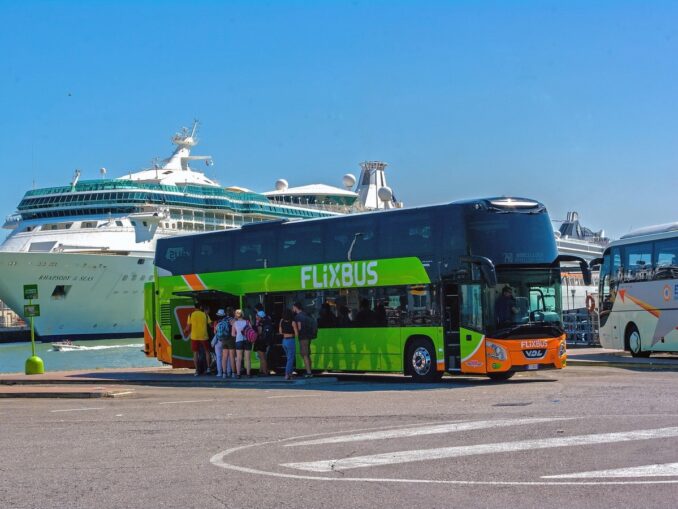
Buses to Venice depart from both Rome Tiburtina Bus Station (most services) and Rome Anagnina Bus Station. They arrive either in Mestre or at Venice’s Tronchetto terminal. From there, you can head straight out to explore Venice by hopping on vaporetto line 2.
By Car
Only a minority of foreign tourists choose this option. The main reason is that renting a car in Italy can be quite expensive.
- Fuel prices here are among the highest in Europe also.
- And don’t even get us started on toll roads — you’ll practically go broke driving on them.
That said, travelers who deliberately choose to drive often don’t worry too much about the cost — personal comfort comes first. Besides, having a car gives you complete freedom to get around and plan your trip however you like.
For example, you could stop along the way to see Florence in one day (one day isn’t really enough, of course, but it’s better than nothing). Spend the night there, then visit Bologna the following day. It’s a fascinating city that doesn’t see nearly as many foreign tourists.
- And, of course, you’ll spend around 6 hours on the road from Rome to Venice
- As well as to pay about €40 in tolls, plus at least €60 — for fuel.
If a car traveling still sounds like a good option for you, read our article on how to travel around Italy by car and what to watch out for.
One more thing to keep in mind: fuel at motorway service stations is significantly more expensive than at pumps along regional roads. Simply leaving the motorway to refuel can save you a decent amount.
For suggested routes and estimated driving costs, try planning your journey here: viamichelin.com.
Where to Stay
We’ve already mentioned hotels in Mestre, along with their pros (relatively affordable prices) and cons (the distance from Venice).
- Keep in mind that Mestre is a convenient base for exploring the wider region.
- For example, you can easily get from it to visit Juliet’s House and other sights in Verona, or take a trip to Treviso, often called «Little Venice.»
In Venice itself, we’d recommend starting with areas near the railway station. That’s because you can find accommodation there for a relatively modest price.
In Cannaregio, take a look at Canal View Studio Flat. In late autumn (the weather in Venice in November isn’t always bad), you can rent it for around €100 per night, plus taxes. This 35-square-meter apartment is 400 meters from the Rialto Bridge and 700 meters from the Doge’s Palace.
Another option, with more space and a slightly higher price tag, is Tadomo — Corte del Cafetier. Styled in a classic Venetian style, this apartment offers guests a lovely bonus: a fantastic view from the balcony. The apartment covers 49 square meters and comes with a kitchen and all the appliances you need for a comfortable stay!
Things to Do
We’ve covered what to see in Venice over 1–3 days in detail in our guide to the city. Here, we’d simply suggest looking beyond the city’s «must have» attractions.
In particular, don’t limit yourself to the central San Marco district. Make time for San Polo (here is Frari located) and Dorsoduro (home to Santa Maria della Salute, the Accademia Gallery, and Peggy Guggenheim Collection).
- Take a walk around Giudecca Island
- Explore the inside of the Church of San Giorgio Maggiore
- Visit the Arsenal district, which tourists rarely venture into.
And, of course, take a look at the island of Murano, explore Burano, and even make it to Torcello.
- Is Venice worth visiting in winter?
- What to see in Venice in a couple of days
- What souvenirs to buy for a woman in Venice?
© Eurotraveler