What to see in Bologna in 1-2 day and more? Main attractions and interesting places to visit in Bologna, walking routes, where to stay overnight? When is the best time to visit Bologna, where to go nearby — Eurotraveler explains.
Bologna is a large Italian city that, for some reason, sees relatively few foreign tourists. Many people have never even heard of it until they start studying the map more closely.
And those who do discover it often decide to visit Bologna… someday. After all, they have so much else to do!
First, they simply must visit magnificent Rome and spend a few days in «glittering» Venice. Then there’s Florence, which deserves at least a day, and Milan, which is an absolute must.
Even when traveling around Italy by car, many people simply drive straight through Bologna without stopping (we did exactly the same thing the first time- unfortunately).
And such a behavior is hardly surprising — this city isn’t exactly a household name. And it’s best known for its university!
Nevertheless, if you can quiet your perpetually restless mind for a little while and take the time to see Bologna in one or two days… you won’t regret it!
- Those who dare to make the city a centerpiece of their next holiday will be especially lucky
- As using it as a base for day trips to Ferrara and Modena, Ravenna and San Marino, even Florence is… convenient!
But let’s start with the essentials. Namely, what places are a must visit in Bologna. Or, at the very least,
What to Look Out For Firsthand?
Leaning towers, arcaded walkways stretching a combined 38 km, and the historic university are Bologna’s main architectural attractions. Interestingly, they are all closely connected.
In the Middle Ages, wealthy citizens were obsessed with building towers. It was a simple and highly visible way to show everyone who was stupider richer and more powerful.
There was little time to worry about laying solid foundations — much like today. As a result, some of Bologna’s surviving towers have a considerable tilt.
Some towers were demolished over the centuries because they were no longer needed. They served very little purpose, and surely the bricks could always be put to better use?
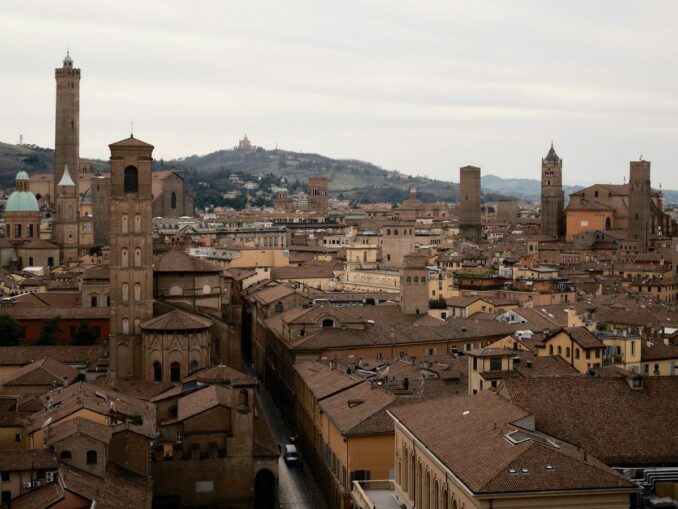
But a few structures somehow survived and now attract tourists. For some inexplicable reason (psychologists could probably explain it), people are always drawn to things that stick out from the crowd.
Perhaps that’s precisely why an extraordinary number of foreign visitors flock to San Gimignano in Tuscany, the «Town of 14 Towers», between May and September.
But we’re not talking about Tuscany here. We’re talking about the main city of Emilia-Romagna!
What truly made Bologna’s residents wealthy was
The University
Founded in 1088, it is the oldest university in Europe. Students from practically every corner of the continent (and today — the world) have been coming here for centuries to study. Naturally, they helped enrich the local population — and continue to do so.
- Although that’s debatable: studying at the University of Bologna today isn’t nearly as ruinously expensive as you might imagine.
In the Middle Ages, wealthy Bolognese residents actively expanded their fortunes by capitalizing on the university’s popularity. Houses grew larger, partly through the extension of upper floors that literally overhung the streets.
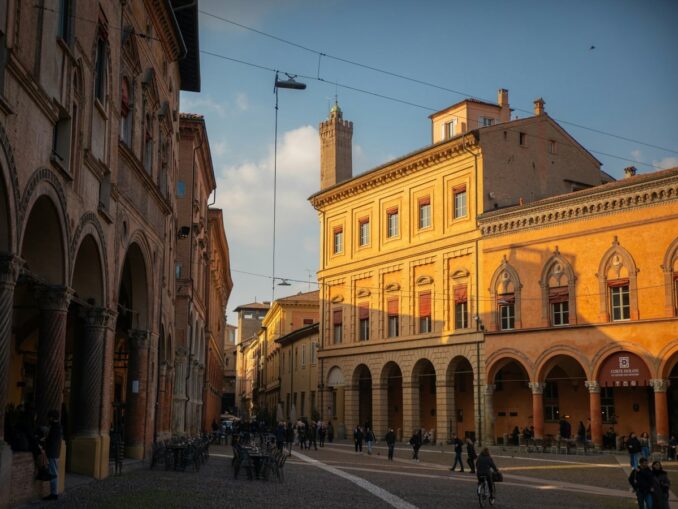
- It’s quite likely that this is how Bologna’s famous arcades, or porticoes, came into being
- They are arguably the city’s most important attraction and its defining symbols!
Numerous and extensive, and sometimes exceptionally beautiful, these galleries originally served a very practical purpose. After all, those extended upper floors had to rest on something, didn’t they?!
Things to See in Bologna
Once there was no shortage of money to spend, the wealthy turned to building towers. There wasn’t enough money, however, to finish the Cathedral of Saint Petronius, the city’s patron saint. To this day, its facade remains a curious mix of exposed brick and marble.
- Inside, you’ll find surviving 15th- and 16th-century frescoes and historic organs.
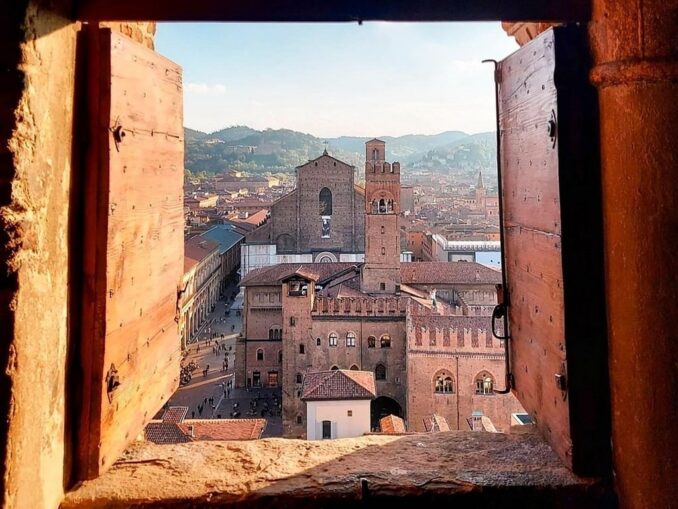
The cathedral stands on Piazza Maggiore, or the Main Square. After visiting it in Bologna — and how could you possibly skip it? (practical information is available here: basilicadisanpetronio.org/en/) — take a closer look at the surrounding palaces.

The elegant Palazzo d’Accursio rises beside the cathedral, while Palazzo Re Enzo stands opposite.
Admire the impressive 16th-century Fountain of Neptune and ask yourself: just how much do the city’s residents dream of the sea they don’t have? Then head down Via Rizzoli.
This street will take you to two of Bologna’s main attractions in just a few minutes.
- The Garisenda and Asinelli Towers are impressive even from the outside
- You can also climb the Asinelli Tower, which stands 97 meters tall, for a bird’s-eye view of Bologna.
The Asinelli family tower is believed to have been built in the early 12th century, between 1109 and 1119. Today, it officially holds the title of the world’s tallest leaning tower!
Tourists are not allowed to climb the Garisenda Tower, as it has become far too «tired.» Its height has had to be reduced twice by dismantling the upper levels to prevent them from collapsing. The structure now stands 48 meters tall.
You can buy tickets for the Asinelli Tower on the official website: duetorribologna.com.
Where to Eat
After taking in the views from above, it’s time to immerse yourself in the heart of the historic Quadrilatero market district. Stop at one of the local taverns and try pasta with Bolognese meat sauce.
Alternatively:
- stock up on prosciutto, cheese, bread, olives at Mercato di Mezzo
- and head to the famous Osteria del Sole.
They don’t serve food here — you have to bring your own — but they do pour wine and beer! The wine-soaked atmosphere that has built up over centuries might be a little overwhelming for some, but the place’s charm is undeniable.
You can still find a seat at this characterful osteria during the first half of the day. In the evenings, however, it’s packed with lively groups of Italians!
What to Try
Let’s be clear: skipping lunch or dinner in Bologna, widely regarded as Italy’s culinary capital and nicknamed «La Grassa» (the Fat One), would be practically criminal. We recommend trying:
- tagliatelle,
- Bolognese lasagna,
- and tortadella, the local sausage.
Wash it all down with a glass of Lambrusco or Sangiovese wine.
After such a hearty meal, there’s no need to rush anywhere — why spoil such wonderful culinary memories? Just wander through the streets!
The Pinacoteca
The Pinacoteca Nazionale di Bologna, the city’s art gallery, may not impress you if you’ve already seen the collections at the Uffizi, let alone the Hermitage or the Louvre. However, anyone who appreciates medieval Italian painting, particularly religious art, will find plenty of peace and inspiration here.
The collection includes many works by Italian artists who are little known today. But Bologna’s Pinacoteca also houses paintings by Giotto, Raphael, Tintoretto, Perugino, and Reni.
The museum is closed on Mondays. For opening hours and ticket prices, it’s best to check the official website: pinacotecabologna.beniculturali.it/it/orari-e-biglietti.
Where to Stay Overnight and Guided Tours
Staying right in the city center and paying extra simply to be close to historic buildings isn’t necessarily the best choice in Bologna. Of course, it’s up to you, but we’d recommend staying a little way from the historic center.
Not too far, though — about a 10-minute walk!
From this perspective, Affittacamere Ambra, on Via Irnerio near Montagnola Park, looks like an excellent option. It’s also reasonably priced, starting at €80 for two people in February.
Clean rooms, a great location (cafes right outside, the railway station nearby, and the city center within easy walking distance) — what more could a budget-conscious traveler ask for?
If Affittacamere Ambra has no vacancies, you can try Casa Angelica on the same street, which is at least as comfortable.
As for guided tours of Bologna, they don’t seem particularly cheap. Still, it’s up to you to decide whether about €30 for a two-hour introductory walking tour in your own language is worth the price…
Need to Know
Bologna’s historic center is not particularly small, but you can explore it on foot in just one day. And you can do so regardless of the weather—as mentioned above, the numerous porticoes make walking comfortable even when it rains.
- However, if you’re staying at a hotel some distance from the city center, you may need to take a bus or trolleybus. For more information, visit the city’s public transport website: tper.it
- In 2026, Bologna also plans to launch its first tram line…
You can download the free Roger app for iOS and Android to purchase digital tickets and pay for your journey by scanning QR codes at the validators on board. Alternatively, the validators can read your bank card or virtual card via NFC, and the ticket price will remain exactly the same.
There is no metro system in Bologna, as well as there are no plans to build one in the foreseeable future. And thank goodness for that!
Day 2
The Sanctuary of the Madonna di San Luca is a striking reminder that Bologna lies in a hilly landscape. The views from the hilltop where the basilica stands are truly spectacular. Getting up there, however, takes some effort.
You’ll have to climb 666 steps along the world’s longest covered arcade (yes, another record!), stretching for more than 3.5 km.
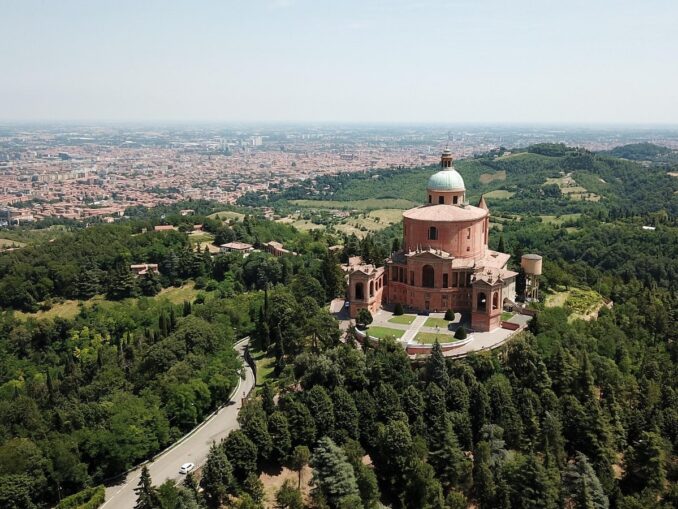
If you make it to the top, you can proudly claim to have explored Bologna! You’ll also have atoned for your sins, according to a local belief that this simple act can cleanse the soul.
The church’s greatest treasure is an icon of the Madonna, painted by the Evangelist Luke. According to legend, it arrived directly from Constantinople.
Where Else to Go
In every sense, Bologna is a central city in Italy. It sits at the crossroads of practically every major route, making it an ideal base for independent travelers exploring the country.
From Bologna, it’s easy:
- to reach Florence (110 km away, around 40 minutes by train) or Siena;
- you can take also trips to Ravenna and San Marino, explore Ferrara in one day (just half an hour by train), visit Modena or Parma, or even head all the way to Milan!
If you have more time, explore the entire wonderful region of Emilia-Romagna, venture into Tuscany, or travel as far as Lombardy. And taking a trip from Bologna to relax on the Adriatic coast is easy, too!
When is Better to Go?
According to meteorologists, Bologna is often damp. Travel guides say it’s always been that way. Apparently, this is why residents who didn’t want to get their feet wet built so many covered arcades.
In short, it’s worth thinking carefully about when to visit and how to organize your trip. Here’s the thing: autumn and spring in Bologna can be extremely rainy, much like London or St. Petersburg.
June is a transitional month, while July and August tend to be sunnier than cloudy. However, during the peak summer months, temperatures stubbornly hover between 32 and 35°C.
This makes spending time in the city’s local «bowl» less than pleasant, as humidity remains high.
On the other hand, locals head to the seaside resort of Rimini in August, leaving Bologna a little quieter.
- September here is drier than June, although 9–10 rainy days a month is still quite a lot.
- The weather tends to reward visitors with clear skies in December and January.
So if you’re thinking of spending Christmas or New Year’s Eve in Bologna, go for it! Freezing temperatures are rare, and the usual daytime temperature is around 3–7°C above zero.
- When Is the Best Time to Take Sightseeing Trips to Rome?
- What to See in Florence in 2 Days?
- What Food to Bring Home from a Trip to Italy
© Eurotraveler